What you are looking atI
The Arsenale
Castello
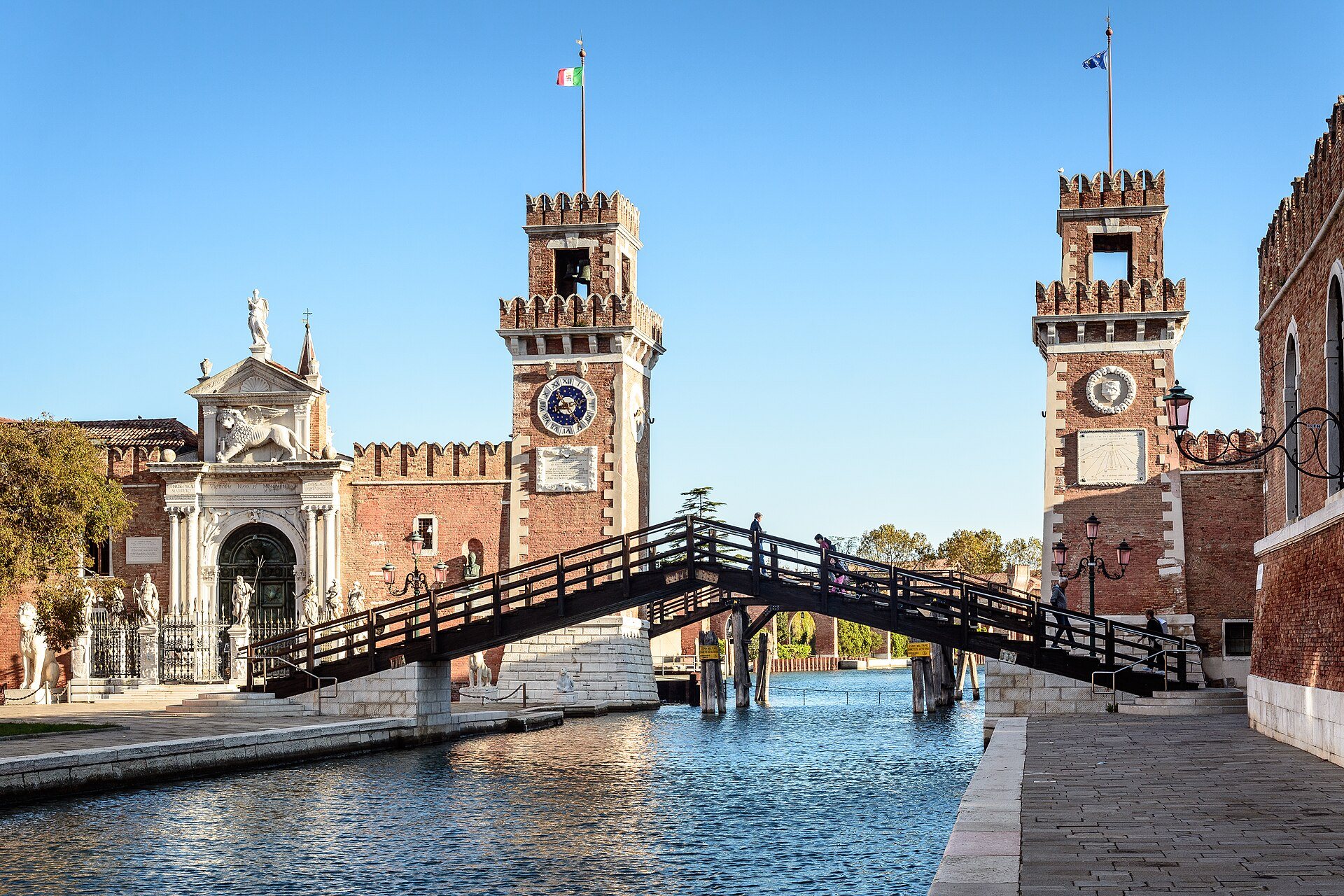
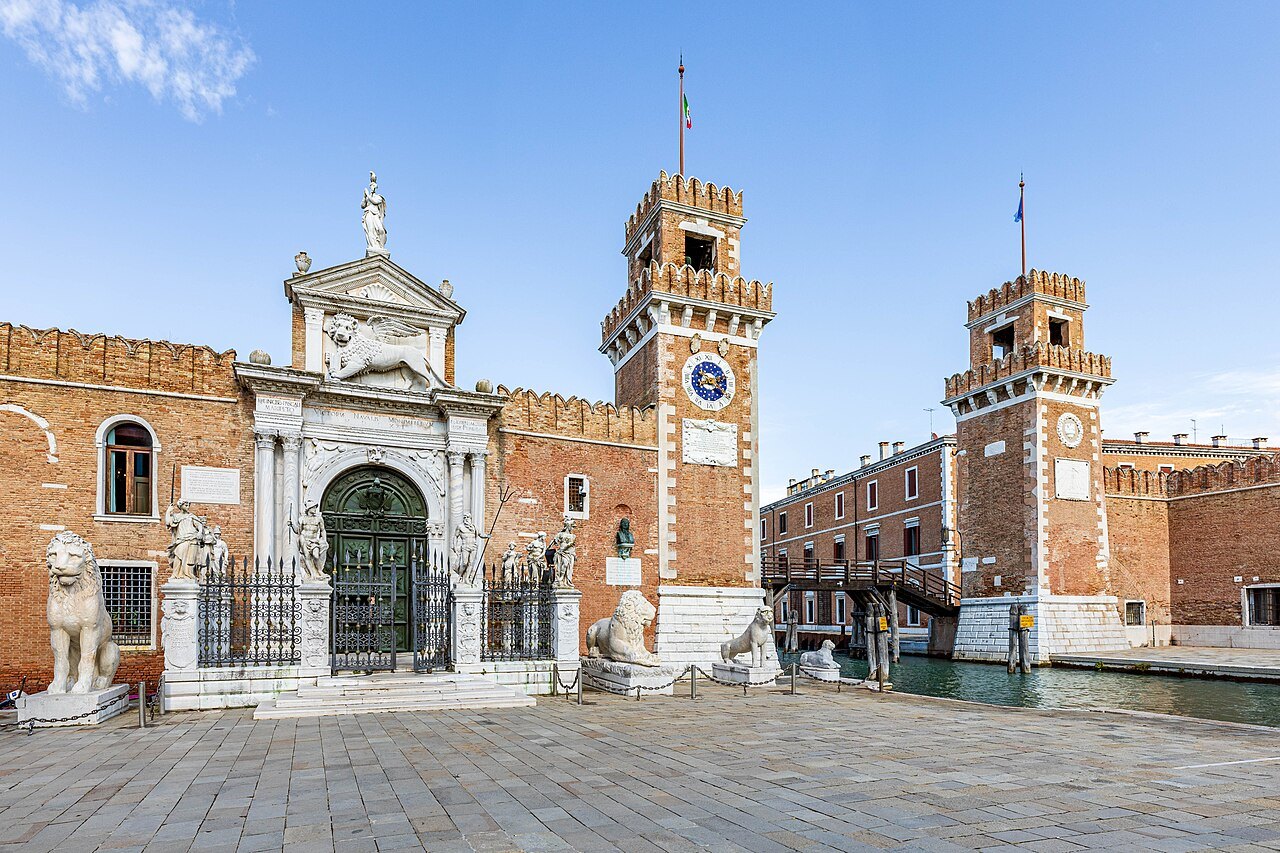
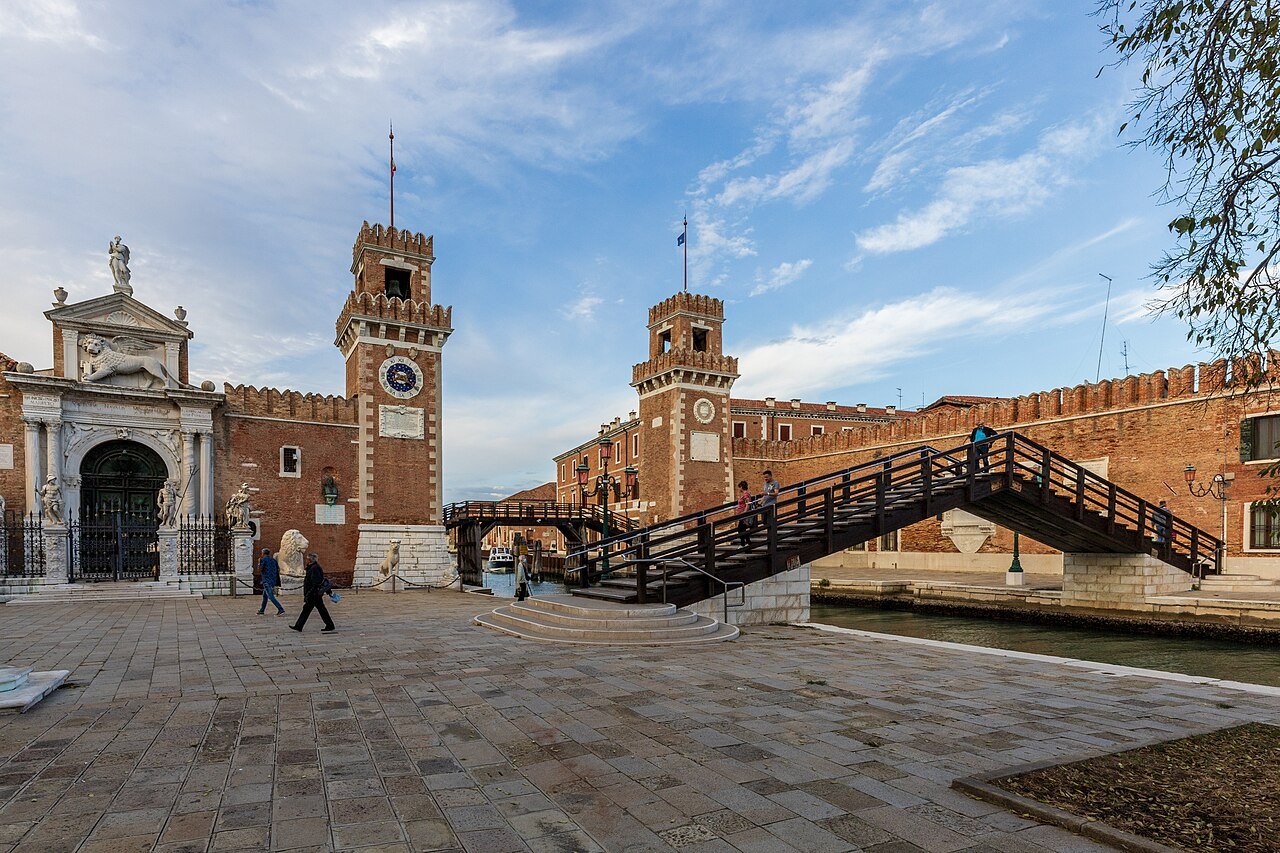
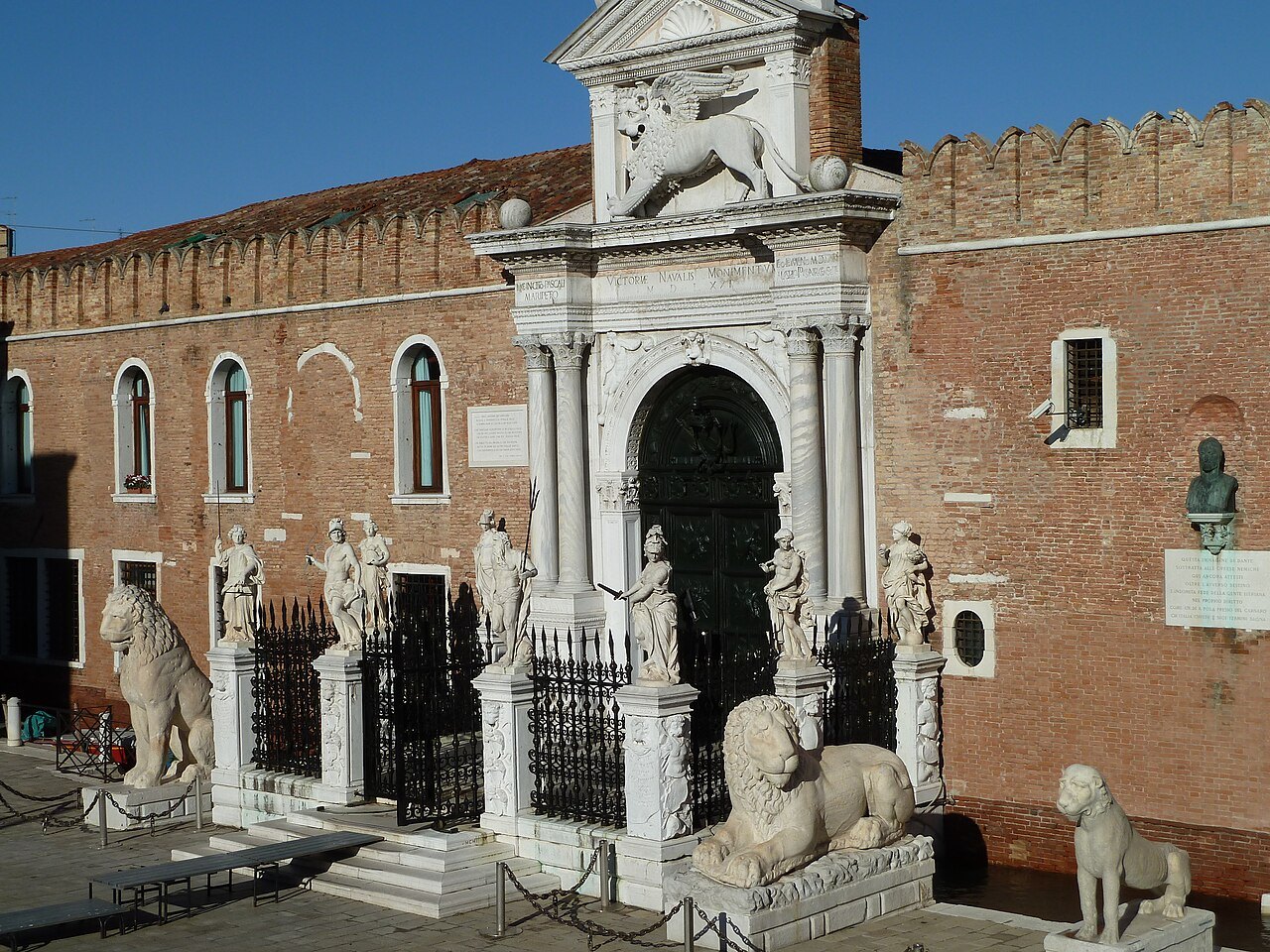
- 1The Porta MagnaThe land gate of about 1460, one of the first works of Renaissance architecture in Venice.
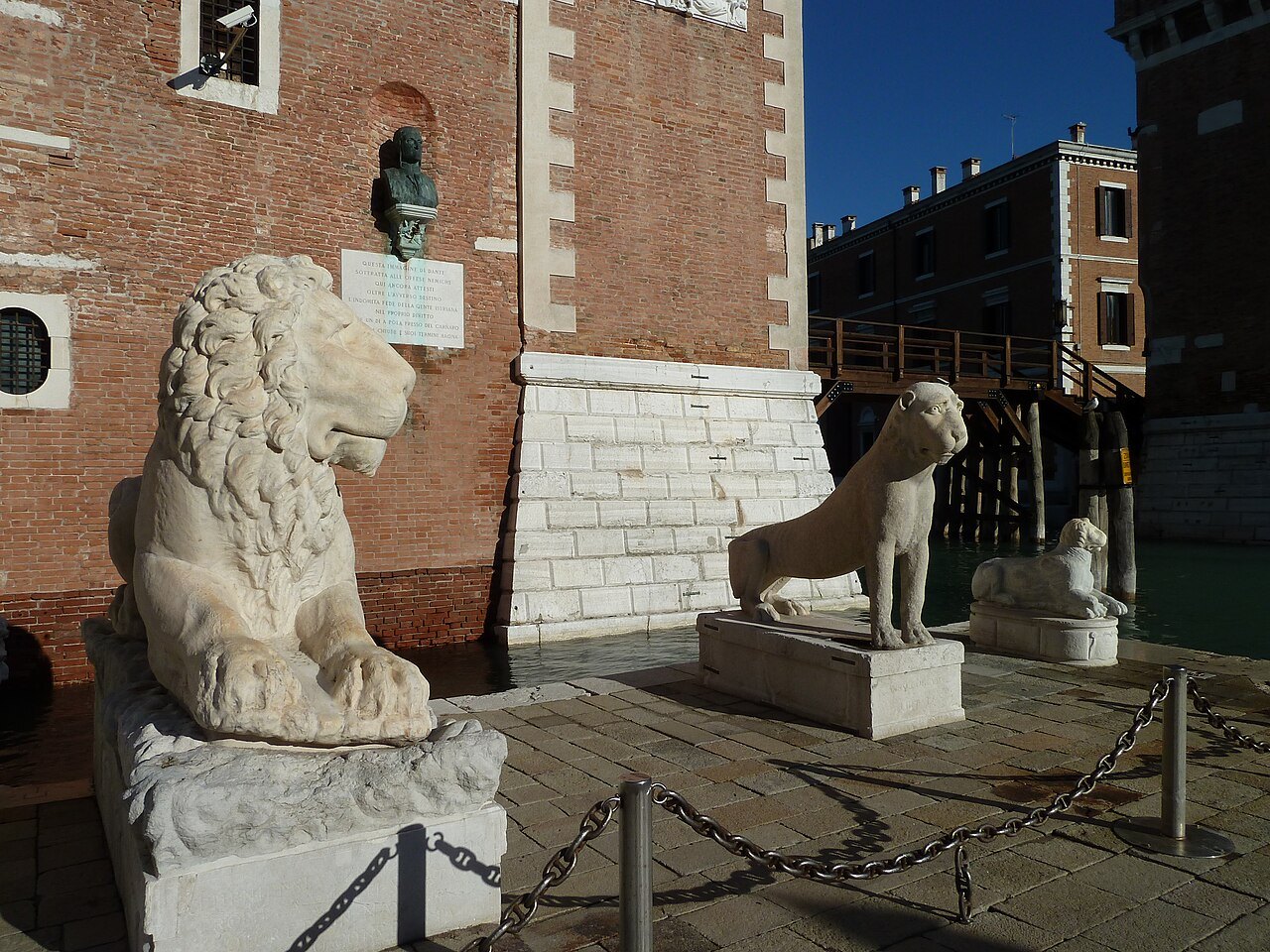
- 2The lionsAncient marble lions looted from Piraeus in 1687, one carved with runes by Scandinavian soldiers.
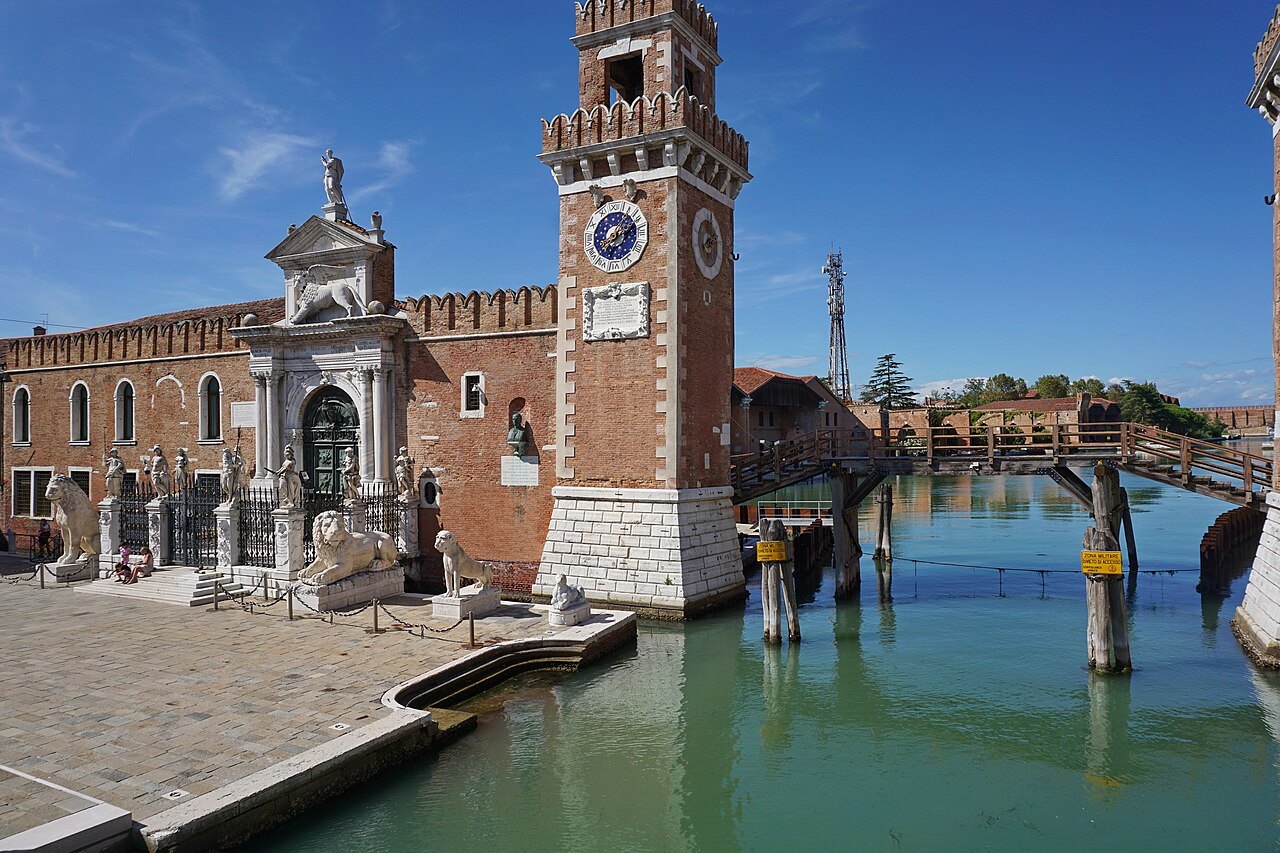
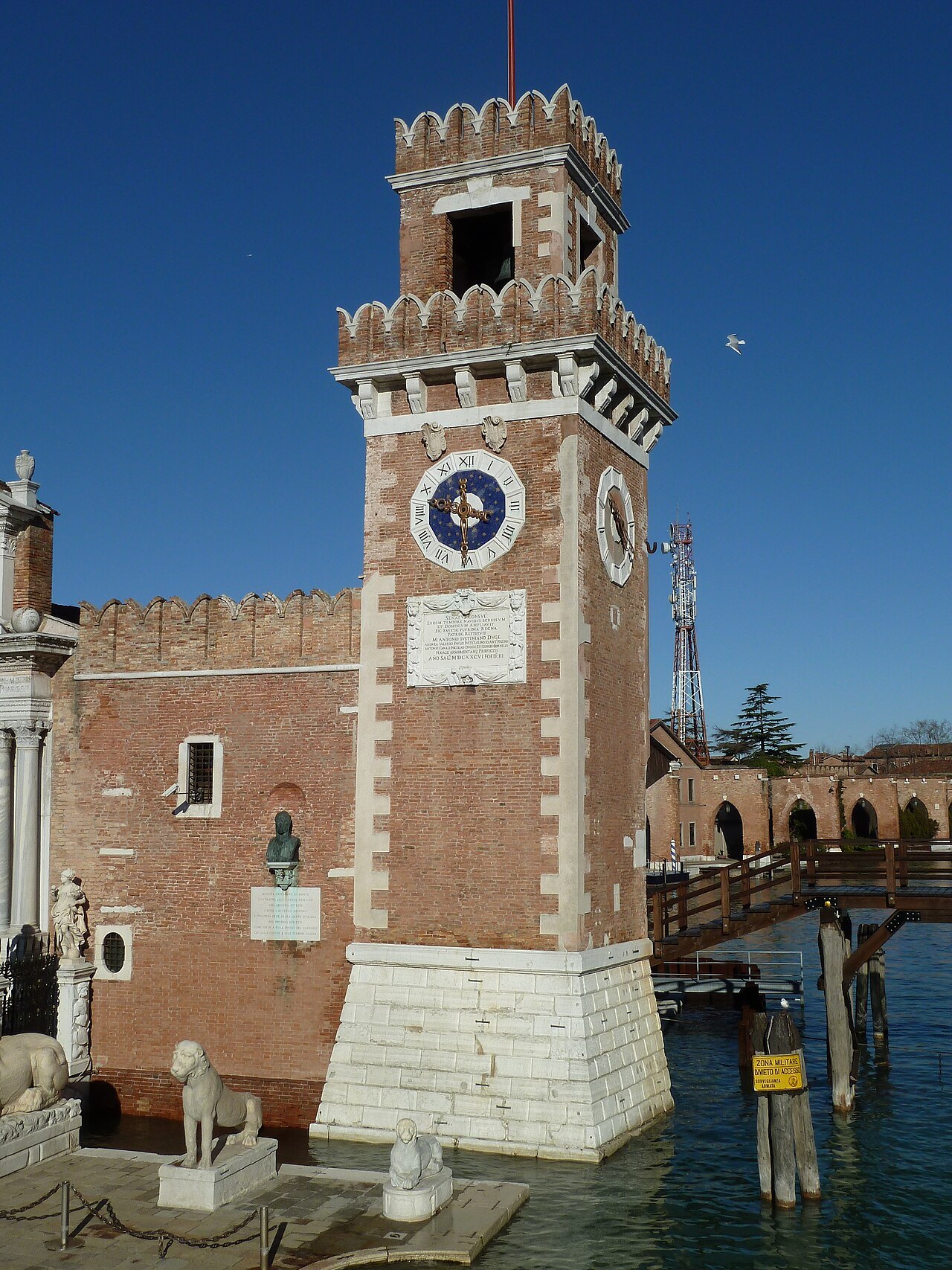
- 3The water gateTwo crenellated towers guarding the canal entrance where galleys went in and out.
- 4The wallsA brick rampart about two miles long around roughly a sixth of the city.
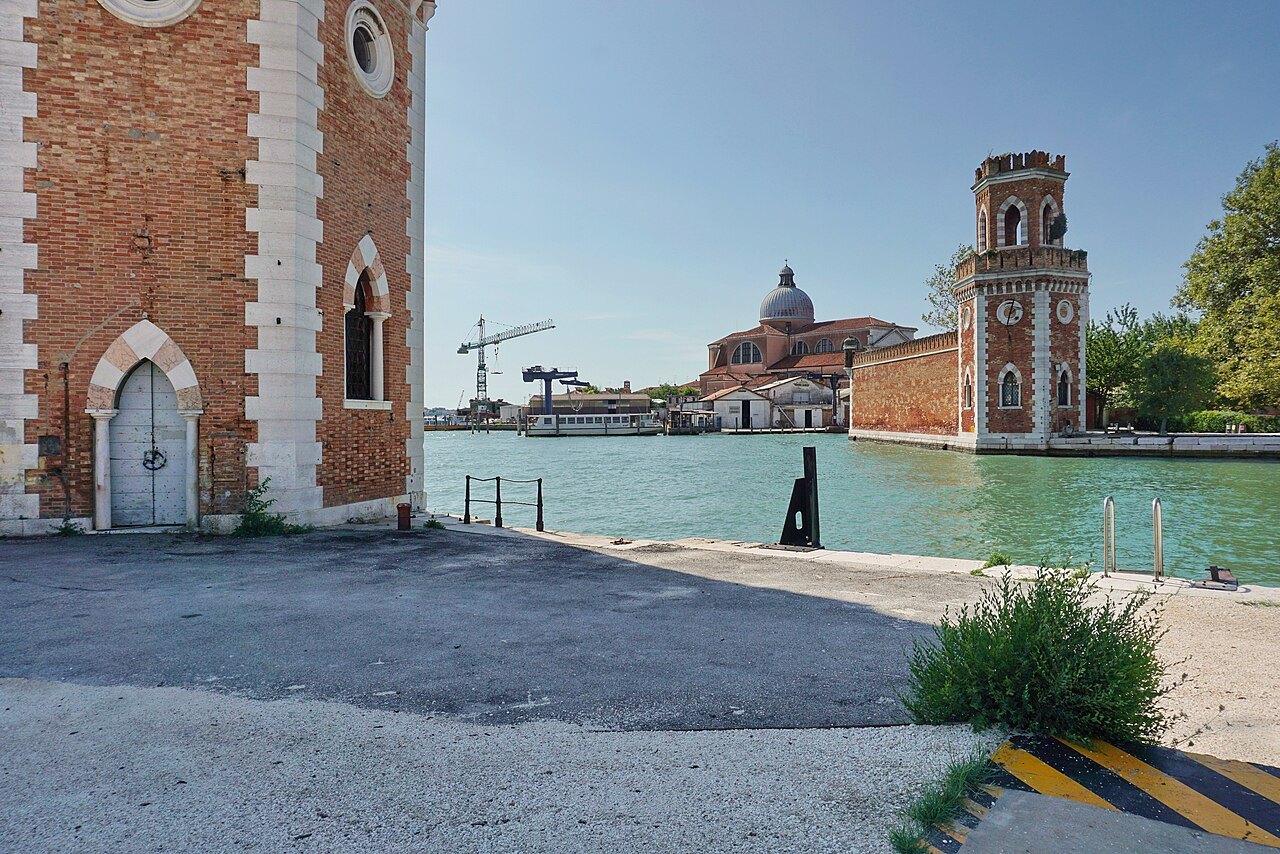
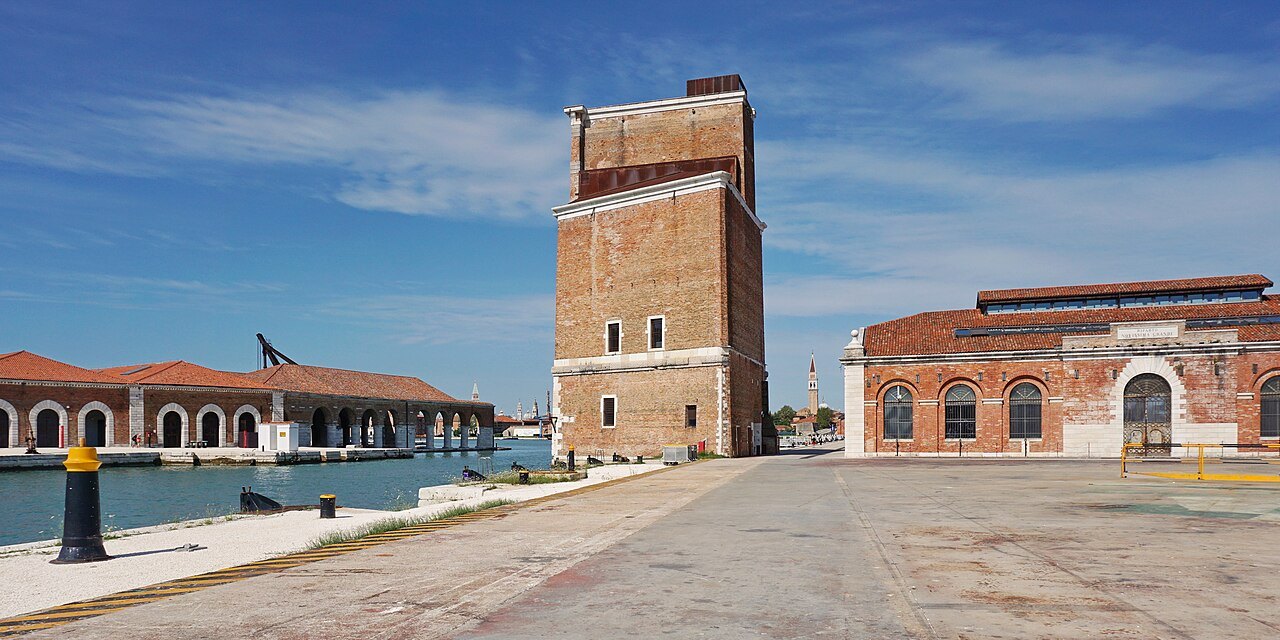
- 5The basinsThe Darsena Grande and the old docks, now a naval base, research center and exhibition space.
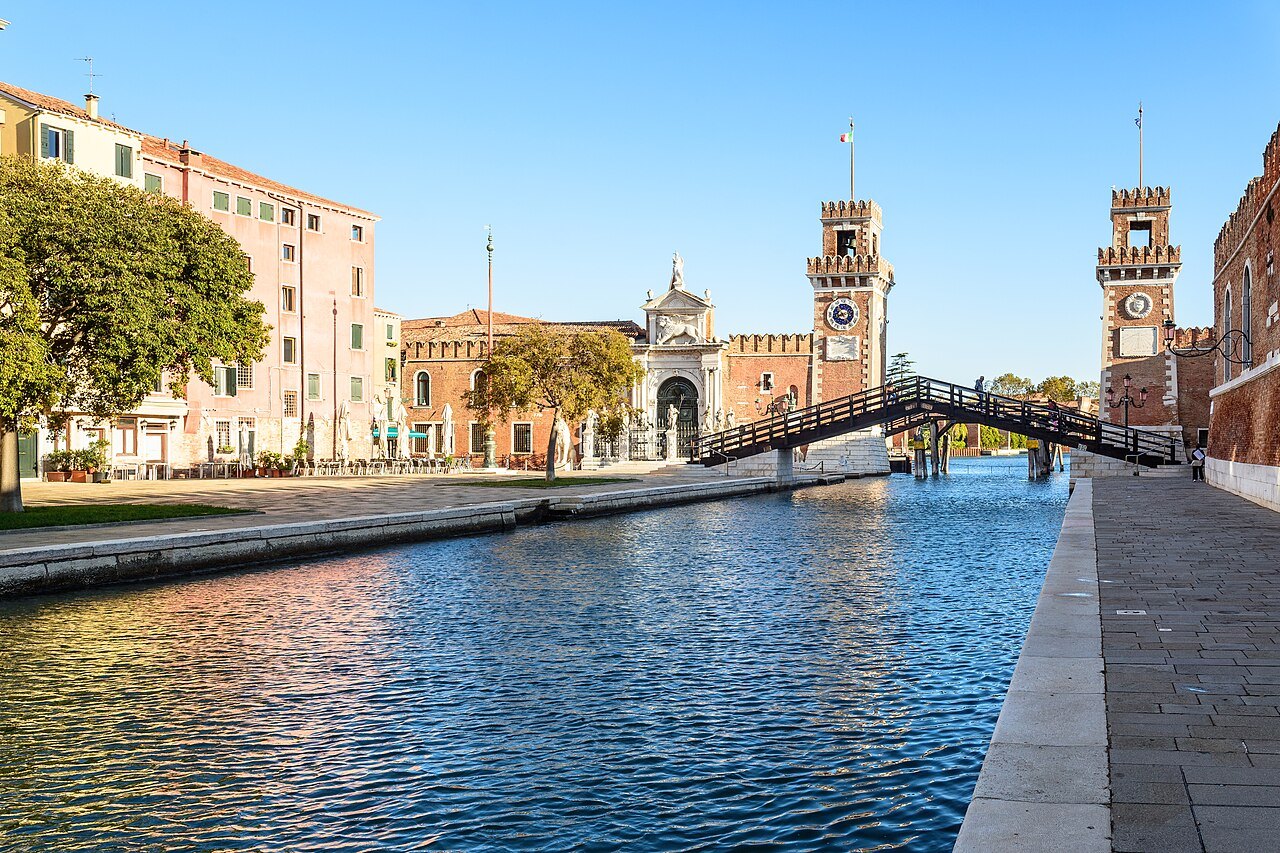
- 6The Rio dell'ArsenaleThe canal from the basin to the gates, crossed by a wooden bridge beside the towers.
The sight in fullII
Reading the place
Why it matters
The Arsenale, the Venetian Arsenal, is the complex of shipyards and armories where the Republic built its navy and much of its merchant fleet. It covers about 45 hectares, 110 acres, some fifteen percent of the city, behind high walls in the sestiere of Castello, and it is still owned by the state.
It is the reason the rest of Venice exists as it does. The city's wealth and power came from controlling trade in the Mediterranean, and that required an enormous fleet: by 1450 more than three thousand Venetian merchant ships were at sea. The palaces on the Grand Canal and the paintings in the churches were paid for by trade that the Arsenale's ships carried and defended. It has been called the largest industrial complex in Europe before the Industrial Revolution, and Dante wrote it into his Inferno.
The first factory
A state yard may have existed here as early as the eighth century; the present Arsenale is traditionally said to have been begun in 1104 under Doge Ordelafo Faliero, though there is no evidence for so precise a date. At first it mainly repaired privately built ships. In 1320 the much larger Arsenale Nuovo was added, and from then on the state's navy and its great merchant galleys could be built and fitted out in one place.
Venice developed ways of building ships that no one else matched. Galleys were built frame-first, faster and with less timber than the old hull-first method; standardized, interchangeable parts were used; and the hulls were moved along a canal from one stage to the next, framing, then planking and cabins, then final assembly, so that the work came to the workers rather than the other way round. At its peak in the early sixteenth century the Arsenale employed some sixteen thousand people and could turn out, arm and provision nearly one galley a day, keeping up to a hundred in different stages of building. Its timber came from the Republic's own forest in the hills of the Veneto.
It also built guns, from bombards in the 1370s to handguns, and in the sixteenth century it experimented with ships for heavy artillery: the galleass, used at the Battle of Lepanto in 1571, and the galleon, a slimmer armed sailing ship. From 1593 Galileo advised the Arsenale's engineers on ballistics, instruments and the rowing of galleys, and the shipwrights' knowledge fed his later book on the strength of materials.
Beyond the walls
The Arsenale shaped the city around it. Rope-making became one of its great trades, and housing for its workers, the arsenalotti, grew up outside the walls in this corner of Castello. Keeping the fleet at sea cost the government almost a tenth of its revenue. The Arsenale's lighter guns went to war on land too: the condottiere Bartolomeo Colleoni, whose statue stands at Santi Giovanni e Paolo, is usually credited as the first to mount them on mobile carriages.
The Republic also built smaller arsenals along its sea routes, repair yards and naval stations in Greece and Crete, at Corfu, Methoni, Koroni, Chania and Heraklion among others, so that a Venetian galley was never far from a dockyard.
What you see
Most of the Arsenale is off limits to the public, so the sight is its edges. Start at the Campo dell'Arsenale, where the Porta Magna, the great land gate, stands beside two towers. Built around 1460, perhaps by Antonio Gambello to a design by Jacopo Bellini, it was modeled on the Roman Arch of the Sergii at Pula in Istria, then Venetian territory, and it is one of the earliest works of the Renaissance in the city. The winged lion of Saint Mark stands over the arch.
In front of the gate sit ancient marble lions, brought back from Piraeus, the port of Athens, and set here in 1687. The largest, the Piraeus Lion, has runes cut into its flanks, probably by Scandinavian mercenaries in the eleventh century.
From the wooden bridge beside the gate you look along the Rio dell'Arsenale to the water entrance, flanked by two tall crenellated towers, where the galleys once came out into the lagoon. Walk along the outside of the walls on the Fondamenta dell'Arsenale and the Fondamenta dei Forni to see how long they are; the rampart runs for about two miles.
The Arsenale today
Much of the Arsenale was destroyed under Napoleonic rule and later rebuilt for use as a naval base, which part of it still is. Other parts have been restored after years of neglect: the complex houses a research center, the operations center of the MOSE flood barriers that now protect the lagoon from the highest tides (see the lagoon), a center for preserving historic boats, and exhibition spaces used in the years of the city's great art exhibition.
Nearby stands the Museo Storico Navale, the naval history museum, which belongs to the same story.
How to visit
The walls, the gate, the lions and the canal can be seen at any time from outside, free. The inside of the Arsenale opens to visitors mainly when exhibitions are held there; check what is on before you plan a visit around it. The nearest water-bus landing is Arsenale, on the Riva, and on the north side of the city a landing called Bacini sits inside the old basins, which gives a glimpse within the walls.
It fits into a walk through Castello, from Santi Giovanni e Paolo east to the Arsenale and on to the gardens and Sant'Elena, or along the Riva degli Schiavoni from the Doge's Palace.
Where to go nextIII
Nearby
- Nearby · CastelloSanti Giovanni e PaoloThe Dominicans' vast brick church, consecrated in 1430, where the funerals of the doges were held and twenty-five of them are buried, with Verrocchio's bronze Colleoni riding in the campo outside.Read the page →
- Nearby · San MarcoThe Doge's PalaceThe seat of the Republic for a thousand years: the doge's home, the council chambers, the courts and the prisons in one pink-and-white Gothic palace on the water, with the Bridge of Sighs at its back door.Read the page →
- Nearby · Isola di San GiorgioSan Giorgio MaggiorePalladio's brilliant white church on its own island, facing the Piazzetta across the basin: built between 1566 and 1610 for a Benedictine monastery, with Tintoretto's Last Supper inside and one of the best views in Venice from its bell tower.Read the page →