TIME, ZODIAC, AND BELLS ABOVE THE PIAZZAI
How does the clock on the Torre dell'Orologio tell time?
How the zodiac dial, moon panel, and bronze Moors on Venice's clock tower mark the hours above Piazza San Marco.
The answer in fullII
Read on
Where the Tower Stands
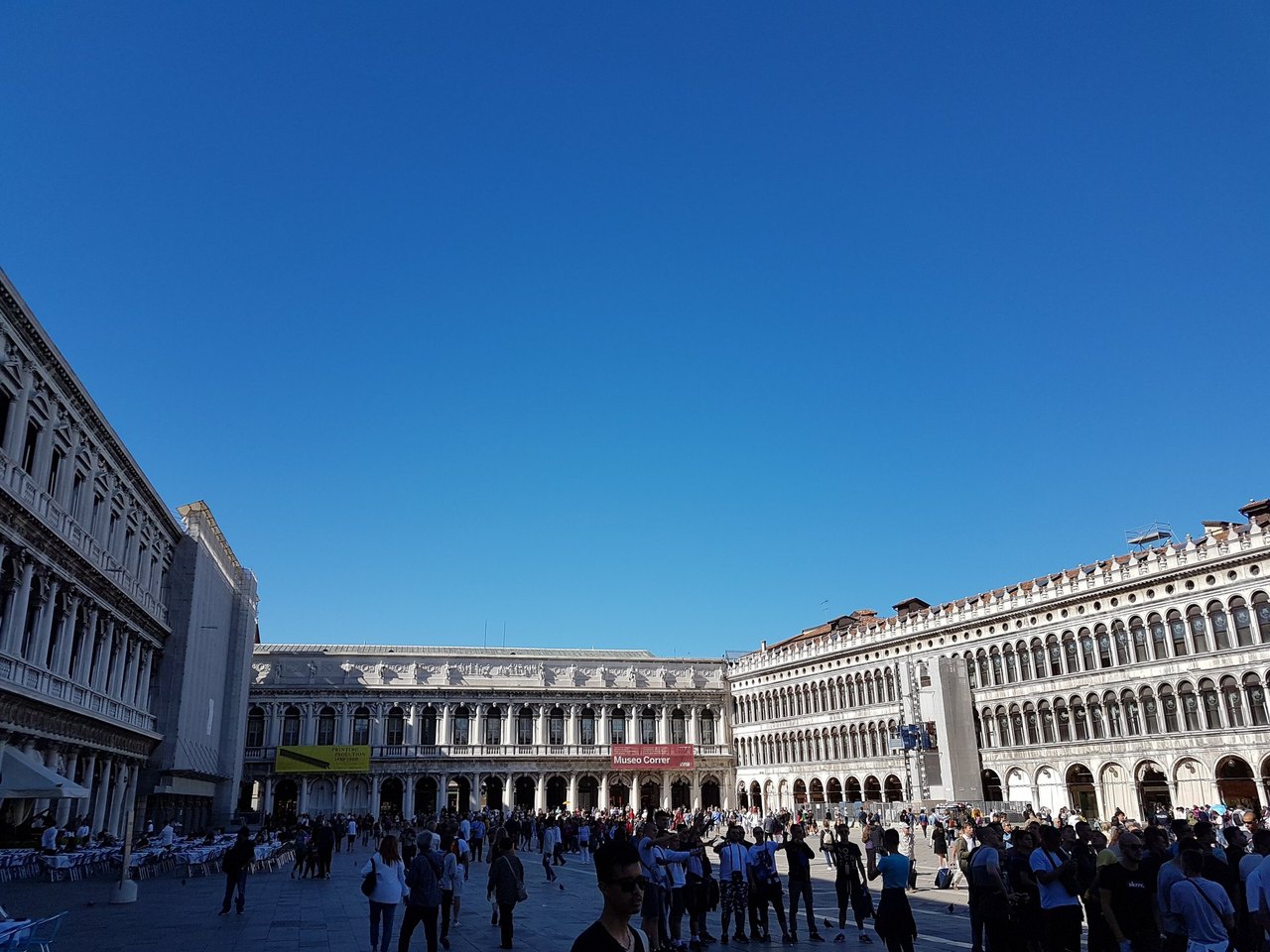
The Torre dell'Orologio rises on the north side of the Piazza, next to the Piazzetta dei Leoncini, where two marble lions presented in 1722 face toward the basilica. The tower stands above a tall archway, and through that archway runs the Merceria, the chain of shopping streets that leads toward the Rialto, the old commercial heart of the city.
Construction of the tower was completed in 1499, part of the long building campaign that gave Piazza San Marco much of its present form, alongside the Procuratie Vecchie to the west and, later, the Procuratie Nuove across the square. The tower's position astride the Merceria meant that anyone entering Venice's busiest shopping street from the square passed directly beneath its clock.
From anywhere in the square, the clock face is visible well above the archway, set into the tower's upper section, with an open terrace further up still where the hour bell hangs. The whole arrangement was built to be read at a distance, by anyone standing in the Piazza, rather than examined up close.
Visitors who want the clearest view of both the dial and the Moors together should stand back toward the center of the Piazza rather than close under the arcades, since the tower's details are easier to read from a short distance than from directly beneath, where the archway and passing crowds tend to get in the way.
The Dial: Hours and the Zodiac
The main face of the clock is a large circular dial, painted in blue and gold and set into the tower below the terrace. Around its rim the hours are marked in Roman numerals, and a single hand reaches from the center to the current hour, moving around the full circuit of the dial over the course of a day.
Around that ring of hours runs a second band showing the twelve signs of the zodiac. The same hand that points to the hour also tracks the sun's apparent position against this band as the year turns, so the dial can be read for both the time of day and, in a rough way, the season.
This double reading, hour and zodiac together, was typical of large public clocks of its period, meant to serve a city that set its working day and its religious calendar by the same instrument. A visitor today only needs to glance at the hour hand against the numerals; the zodiac band rewards a slower look.
Because the clock stands high above the square, bring a pair of binoculars or simply wait for a quieter moment near the center of the Piazza if trying to follow the zodiac band or the moon dial in any detail, since both are set well above eye level, well out of reach from the ground.
The Moon and the Stars
Below the main dial, a smaller painted panel shows the phase of the moon, turning gradually across the lunar month to display a sliver of light or a full circle. Sailors and traders once leaving from the columns at the edge of the Piazzetta toward open water could use this kind of information before setting out.
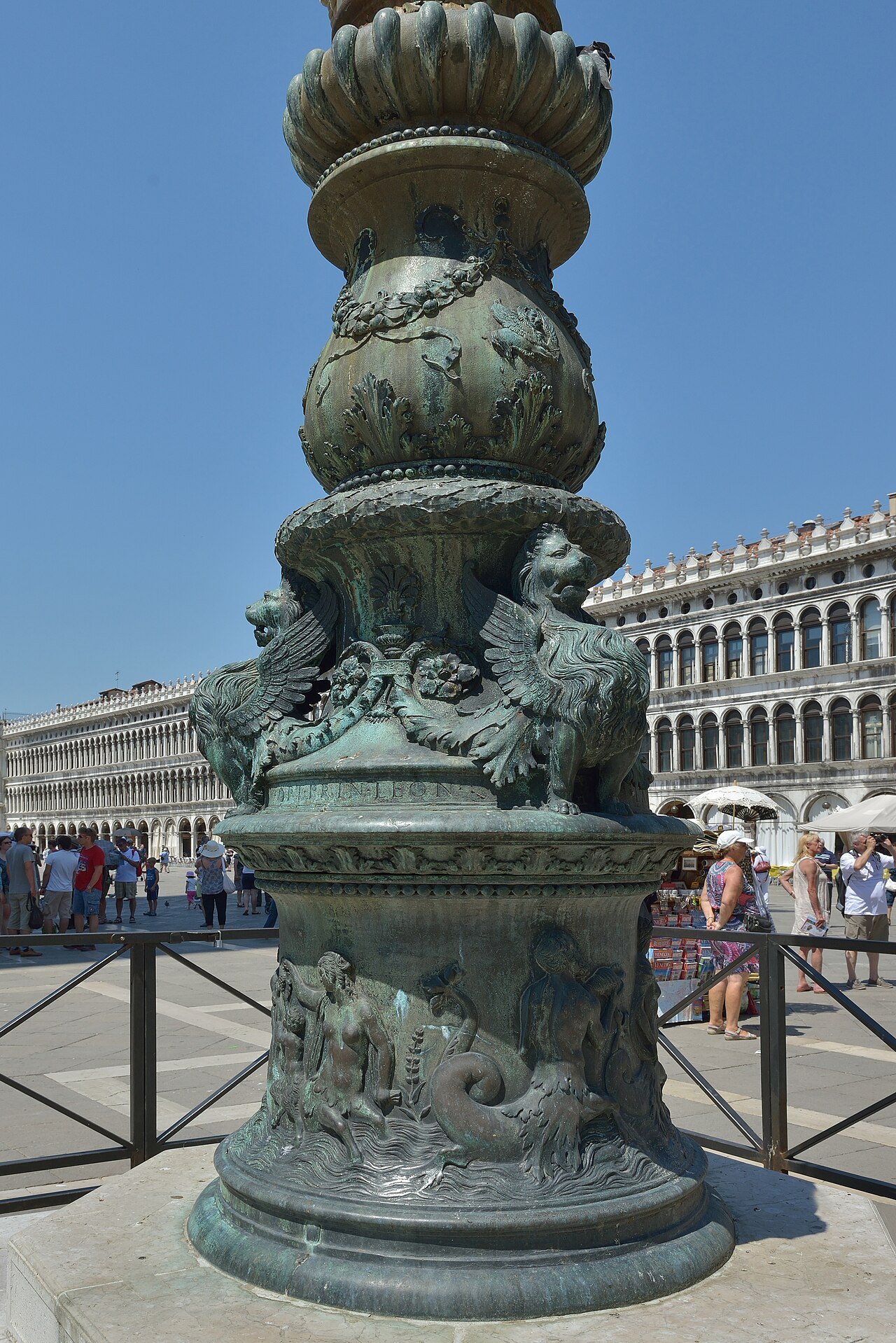
The whole face sits against a dark blue ground scattered with gold stars, echoing the night sky and matching the gilding used elsewhere around the square, including on the winged lion that stands on its column facing the Doge's Palace. Restorations over the centuries have kept the scheme close to its early appearance.
None of these secondary dials needs to be read to know the time of day; a glance at the hour hand against the Roman numerals is enough. They exist for anyone who wants to linger a little longer and work out the fuller picture the tower was originally built to show.
The Moors on the Roof
At the very top of the tower, on an open terrace above the dial, stand two bronze figures known locally as the Moors. Each holds a hammer, and in turn they swing it down to strike a large bell mounted between them, sounding the hour audibly across the whole square below.
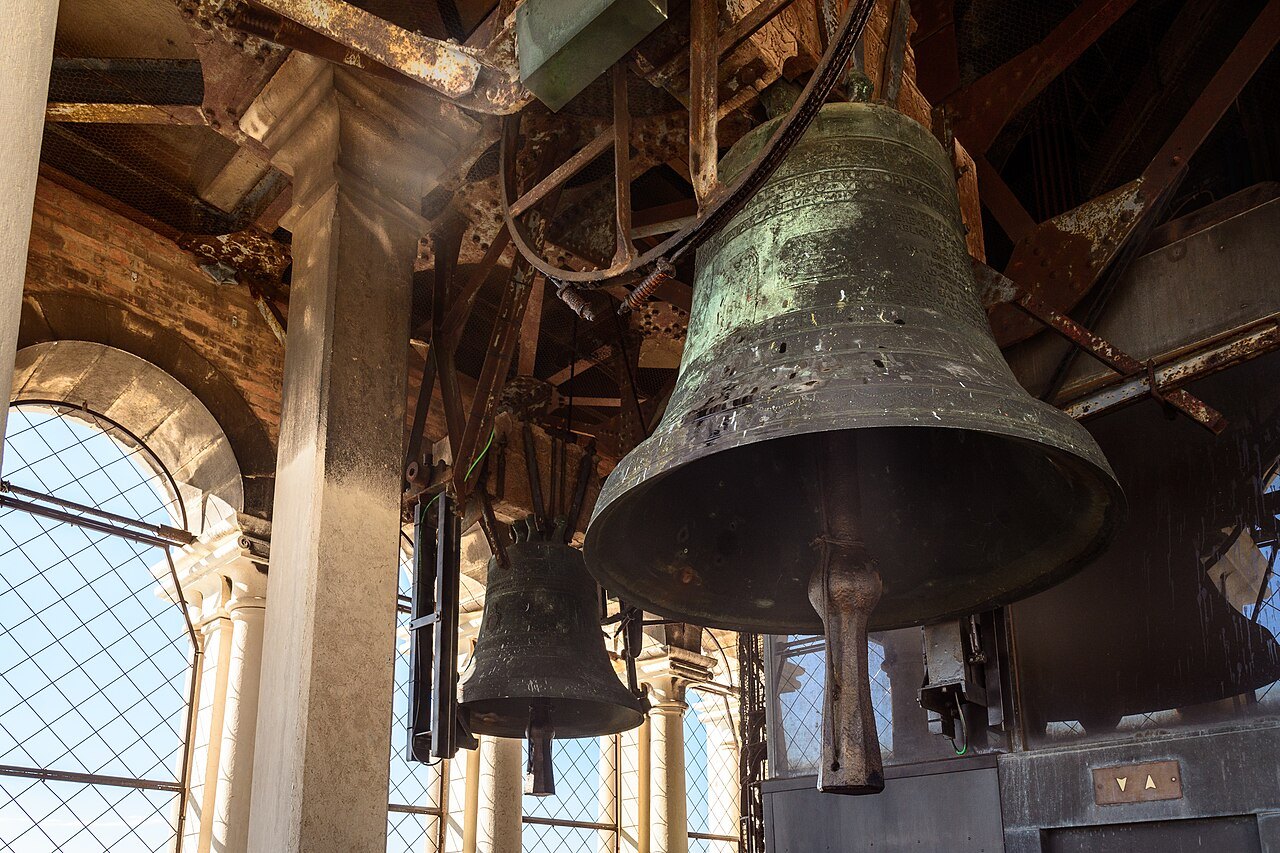
One figure is traditionally described as older and the other as younger, a pairing often read as a reminder of time passing from youth to age, though no document in the record of the square explains the choice further. The bell the two figures strike is the same one Venetians and visitors still hear mark each hour.
Seen from the square, the figures are small against the sky, little more than silhouettes swinging their hammers. Visitors who want a close view of the Moors, rather than of the dial, need to be on a guided visit inside the tower, since the terrace itself is not reached from the Piazza.
The Madonna and the Magi
Beneath the astronomical dial sits a gilded relief of the winged lion of St Mark, the city's emblem, set against the same blue and gold used across the whole clock face. Below the lion is a small shrine-like niche holding a gilded statue of the Madonna with the child, facing out toward the water beyond the Piazzetta.
On two occasions in the religious calendar, Epiphany and the feast of the Ascension, mechanical figures of the three Magi emerge from a side door, led by an angel, and process past the Madonna before returning inside. Visitors standing in the square on those feast days can watch the short procession from below.
Outside those two occasions, the niche stays closed and the figures are not on view. Anyone hoping to see the Magi should check the dates of Epiphany and Ascension for the year of the visit and plan to be in the Piazza itself, since the procession is not repeated on request.
Visiting the Tower Today
The clock face and the Moors can be read and seen from the square at no cost, simply by standing in the Piazza and looking up; this is how most visitors experience the tower. The archway beneath it, leading toward the Merceria, is a public street and open to anyone on foot.
Access inside the tower, to see the clockwork mechanism and to reach the terrace where the Moors stand, is by guided visit only, arranged in advance through the official body that manages the museums around the square. Space on these visits is limited, and the route climbs many steep, narrow stairs.
Anyone planning to join one should check current arrangements, group sizes, and any age or mobility restrictions directly with the museum authority before arriving, rather than assume a place can be found on the day. See booking ahead for how reservations for sights around the square generally work, including at the nearby basilica.
The tower's pageantry fits the rest of the square's history: much of what now looks uniform around the Piazza, from the clock's gilding to the columns at the water's edge, was built, damaged, or restored at different times rather than in one single campaign, a point worth remembering when comparing the tower with other sights around the square.
Read nextIII
More from the journal
- St Mark's BasilicaHow do you visit St Mark's Basilica?St Mark's is a working church with four separate visits, a line that crosses the Piazza on busy days, and a golden interior that rewards knowing where to look. How the visit is divided, how to book, when to go, and a route through the church, the Pala d'Oro and the loggia of the horses.Read the piece →
- When to ComeWhen is the Venice Carnival, and what actually happens?The Carnival of Venice fills the city with masks and costumes for about two weeks before Lent. When it falls, where its history comes from, what the traditional masks are, what visitors actually see, and how to plan a visit around the busiest weeks of the winter.Read the piece →
- When to ComeAcqua Alta in Venice: the Tide, the Sirens and the WalkwaysBetween autumn and spring, exceptional tides flood the lowest parts of Venice. What causes the acqua alta, how the levels are measured, what the sirens mean, where the raised walkways go, what the MOSE barriers changed, and how to plan a day around a high tide.Read the piece →