GOVERNMENT BY COMMITTEEI
How was a doge of Venice elected?
How Venice chose its doge, and what the Doge's Palace still shows of a power deliberately kept in check.
The answer in fullII
Read on
A republic, not a monarchy
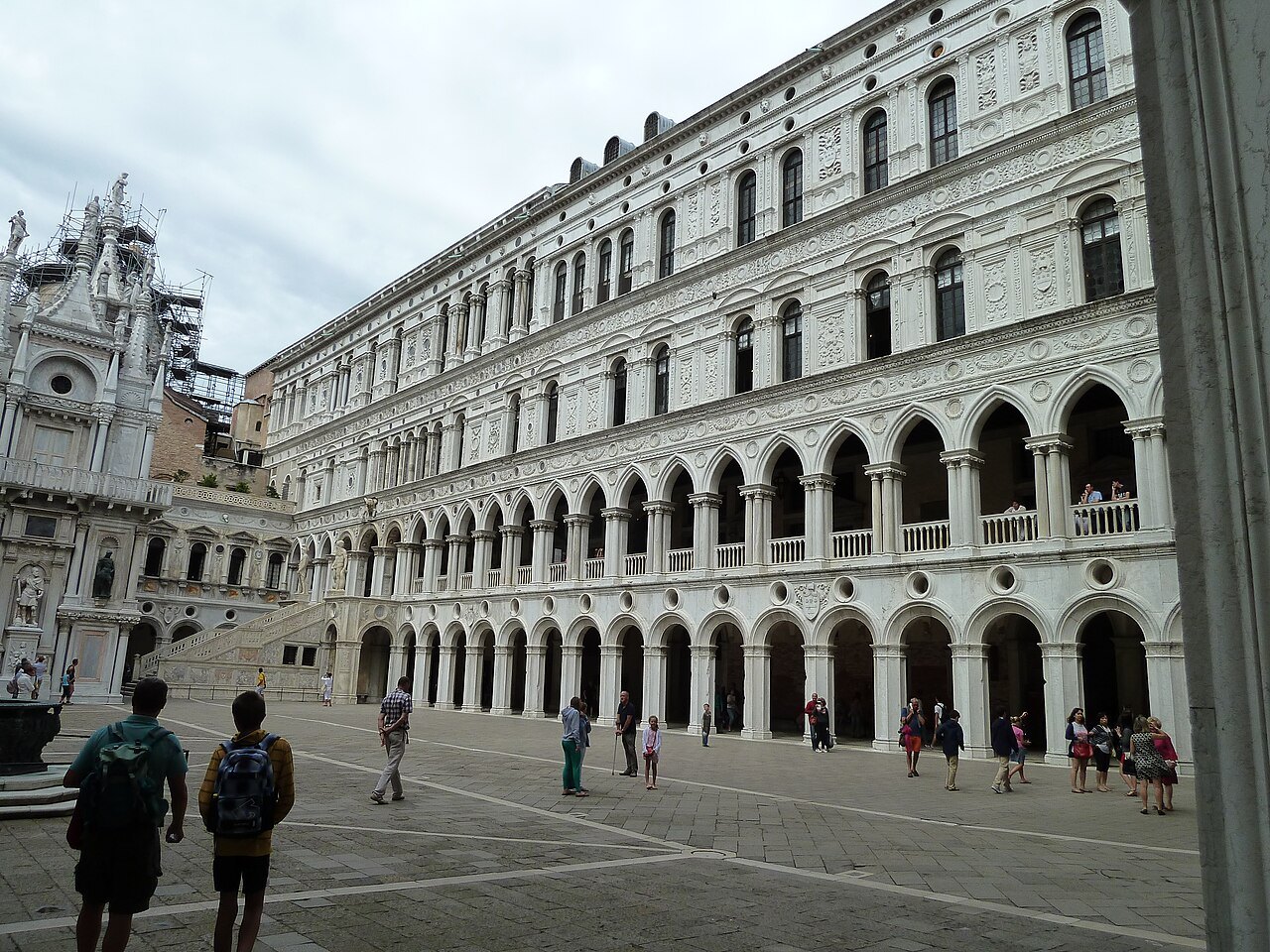
The Doge's Palace was the government of Venice in a single building. It held the doge's own apartments alongside the chambers of the Great Council, the Senate and the Council of Ten, the courts, and the prisons, and it did this work until the Republic fell to Napoleon in 1797.
The doge himself was the elected head of the Republic, not a hereditary ruler. The building he lived and worked in makes that plain: his private rooms sit beside the council chambers built precisely to watch him, and the whole plan reads as a government designed around one idea, that no single man should rule Venice alone.
Since 1923 the palace has been a museum, and it remains the building to visit if the question is how the Republic actually governed itself, through a council of every adult male patrician, councils nested inside councils, and a doge whose authority was hemmed in by design.
The Great Council as the electorate
The Chamber of the Great Council, fifty-three meters long and twenty-five wide, is one of the largest rooms in Europe and was built to hold the body that stood at the center of Venetian government. Every male patrician over the age of twenty-five had a seat in it.
This assembly, not the doge, was the source of authority in the Republic. It filled the senior offices of state, and the frieze of doges' portraits that runs around the chamber, continuing into the neighboring Scrutinio Room, is a record of the men who held the top office that the Council effectively controlled.
The scale of the room is itself a statement. A government built around an assembly of this size, deliberately too large for any one patrician family to dominate, could not easily hand power to a single ruler, even one it had just elected.
Checks built around the doge
Beyond the Great Council, the palace held the Senate and the Council of Ten, bodies that shared and limited the doge's authority rather than simply serving under him. The Council of Ten was set up after a conspiracy in 1310, a direct response to a threat against the state.
The ceiling of the Chamber of the Council of Ten, painted by Ponchino with a young Veronese, sits in the same sequence of state rooms as the doge's own apartments, completed by 1510. Walking the route makes the arrangement visible: the doge's residence is surrounded on every side by rooms built for collective rule.
Courts of law were housed in the same building, another sign that judgment of the Republic's own citizens, the doge included in principle, was kept apart from any single office. Nothing in the palace suggests a ruler who governed without oversight.
When a doge reached too far
The clearest evidence of how far the Republic meant to limit its doge is the fate of Marino Faliero, who attempted a coup in 1355. He appears in the frieze of the Great Council Chamber only as a black cloth, marked out from every other doge as a traitor to the Republic.
That single gap in an otherwise continuous row of portraits is a blunt message built into the decoration itself: the office of doge existed within, not above, the system of councils that filled the rest of the building, and stepping outside it ended a reputation as thoroughly as it ended a life.
Earlier doges named in the palace's own history, Sebastiano Ziani who rebuilt it in the twelfth century and Francesco Foscari who extended it toward the Piazzetta in 1424, are remembered for building and governing within that system, not for ruling apart from it.
The building as a record of the system
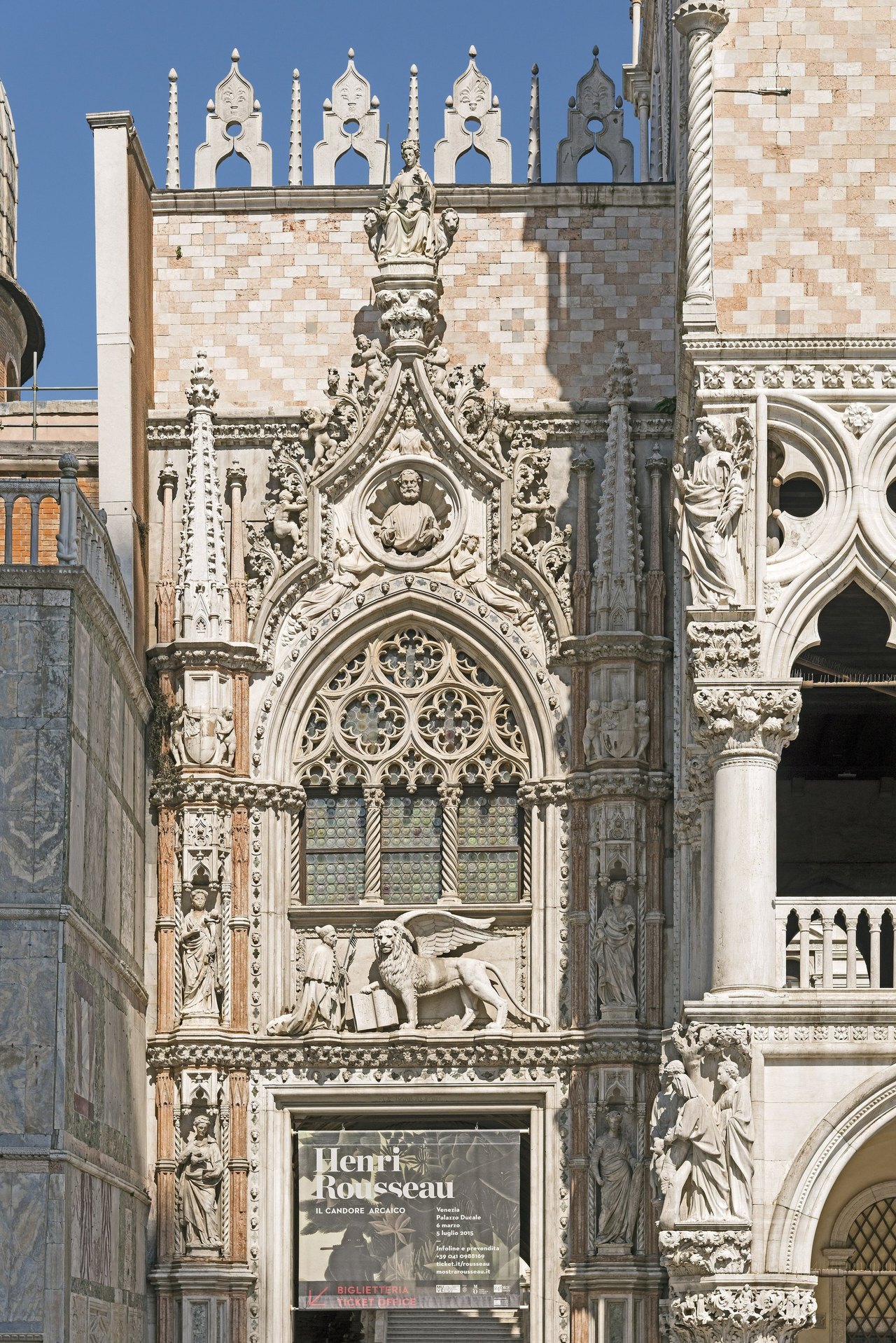
The palace was rebuilt in stages across centuries, and each stage still carries the marks of the government it housed. The Gothic palace seen today was begun around 1340, and Doge Francesco Foscari's extension along the Piazzetta, finished with the Porta della Carta between 1438 and 1442, shows a doge's name attached to the fabric of the building without his image standing apart from it.
The kneeling figure of Doge Foscari before the lion of St Mark, carved on the Porta della Carta, sums up the relationship in stone: the doge shown low, submissive to the symbol of the Republic above him, not raised over it. The original was destroyed on French orders in 1797; the figure now in place is a nineteenth-century replacement.
Fire shaped the palace more than once, destroying the doge's apartments in 1483 and the Great Council Chamber itself in 1577, and each time the Republic chose to rebuild rather than remake the system the rooms expressed. When Palladio proposed a new classical design after the 1577 fire, the Republic rebuilt in the original Gothic style instead.
What the palace shows, and what to check separately
The fact base behind this guide, drawn from the palace's own history and rooms, documents who could sit in the Great Council, which councils checked the doge, and what happened to a doge who broke the system. It does not set out the exact mechanics of a ballot, how candidates were narrowed or how a winner was confirmed.
A visitor who wants that level of procedural detail should ask at the palace itself or check the official site before arriving; the two reserved special visits, the Secret Itinerary and The Doge's Hidden Treasures, cover rooms and records beyond the standard route and are the likeliest place to find it (see booking ahead).
What can be said with confidence from the building itself is the shape of the system: an assembly of patricians, a doge drawn from and answerable to it, and further councils layered on top to prevent any one person, including the doge, from acting alone.
Planning the visit
Allow two to three hours for the palace. Tickets are sold on its official site, and alongside the standard route it offers the two reserved special visits mentioned above, limited to small numbers and the parts most worth booking ahead.
The route runs from the Porta del Frumento into the courtyard, up the Giants' Staircase guarded by Sansovino's Mars and Neptune, through the Golden Staircase to the doge's apartments, and on through the council chambers to the Great Council Chamber itself before crossing the Bridge of Sighs to the prisons.
A cloakroom, an elevator, an audioguide through the Musei Civici app and a café are available in the palace. The Piazza San Marco sits just outside, and a combined ticket with the Museo Correr across the square can be checked on the official site.
Read nextIII
More from the journal
- The Doge's PalaceCan you walk across the Bridge of Sighs?Yes: the Bridge of Sighs is part of the visit to the Doge's Palace, which crosses it to the New Prisons and comes back the other way. What the bridge was really for, where the romantic name came from, how the palace route reaches it, and where to stand for the classic view from outside.Read the piece →
- Piazza San MarcoWhy are there two columns at the water's edge of the Piazzetta?The story behind the two granite columns at the water's edge of the Piazzetta, and what their statues represent.Read the piece →
- St Mark's BasilicaHow do you visit St Mark's Basilica?St Mark's is a working church with four separate visits, a line that crosses the Piazza on busy days, and a golden interior that rewards knowing where to look. How the visit is divided, how to book, when to go, and a route through the church, the Pala d'Oro and the loggia of the horses.Read the piece →