PIAZZETTA SAN MARCO COLUMNSI
Why are there two columns at the water's edge of the Piazzetta?
The story behind the two granite columns at the water's edge of the Piazzetta, and what their statues represent.
The answer in fullII
Read on
Two columns, one gateway
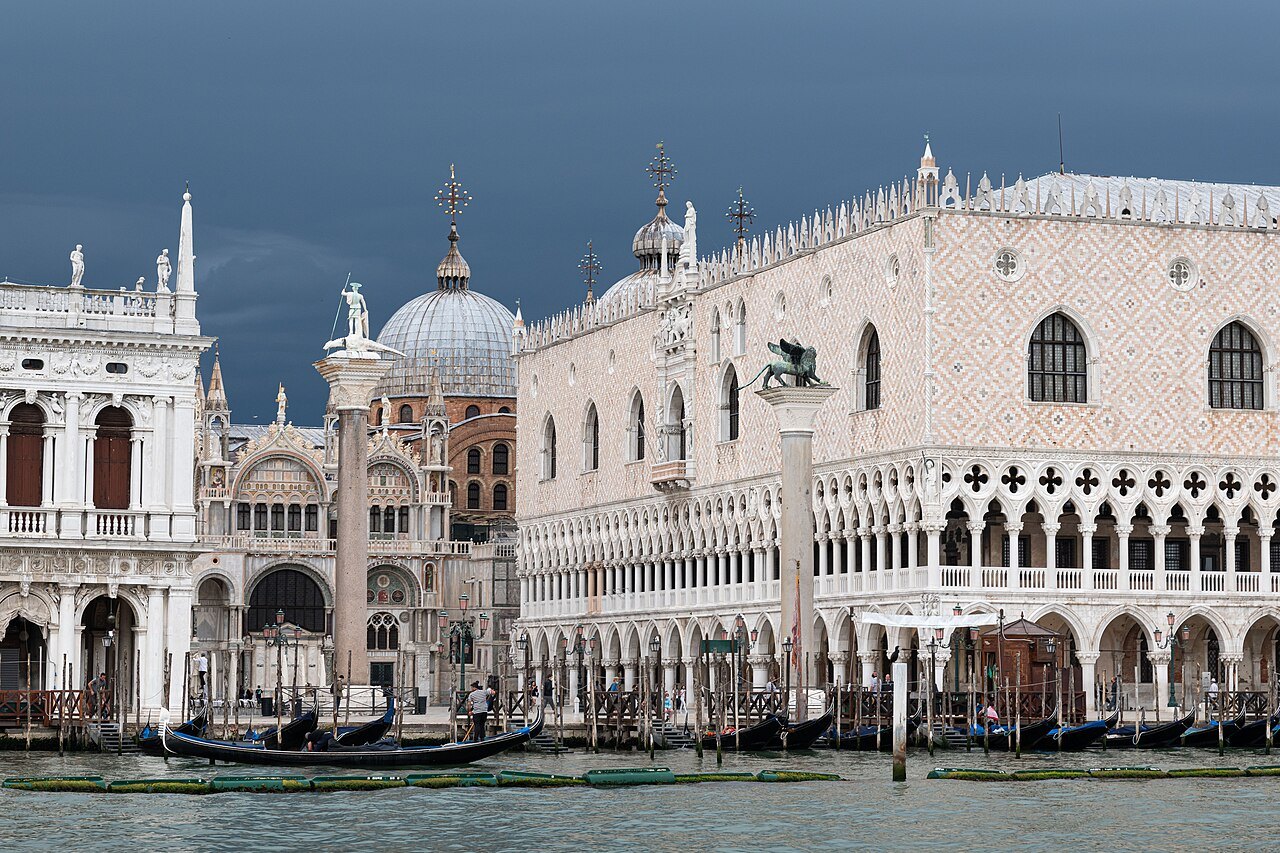
The Piazzetta is the short, separate arm of Piazza San Marco that runs from the corner by the basilica down to the lagoon, with the Doge's Palace on one side and Sansovino's Library on the other. At its open end, right where the paving meets the water, stand two tall granite columns, set apart from everything else around them.
They are the first thing a visitor arriving by boat would have seen for centuries, framing the formal entrance to the city from the sea. One column carries a statue of Saint Theodore, Venice's first patron saint. The other carries the winged lion of Saint Mark, the emblem of the Republic and of the city itself.
Nothing else in the square looks quite like them: plain, heavy, weathered stone shafts, each topped with a single figure silhouetted against the basin and, beyond it, the island of San Giorgio Maggiore. Their placement was deliberate, marking the threshold between open water and the political heart of the Republic.
When the columns went up
The columns are now thought to have been raised around 1268, a dating that comes from later study rather than any contemporary inscription. At that time the water of the basin came in closer than it does today, so the two shafts stood almost directly at the edge of the lagoon rather than back from it as the Piazzetta now appears.
Their function was as much ceremonial as decorative. Anyone sailing into Venice from the sea passed between them, and for a long stretch of the Republic's history, that passage between the columns was understood as the formal gateway into the city, reserved in practice for the grandest arrivals and departures.
The rest of the Piazzetta grew up around that fixed point over the following centuries, as the Doge's Palace, the Library and the old mint, the Zecca, were built and rebuilt along its two flanks, but the columns themselves kept their position at the water's edge throughout.
Saint Theodore and the lion
The statue on one column shows Saint Theodore, standing over a crocodile that stands in for the dragon he was said to have killed. The figure now in place is a copy; the original statue is kept inside the Doge's Palace, out of the weather and off its original perch.
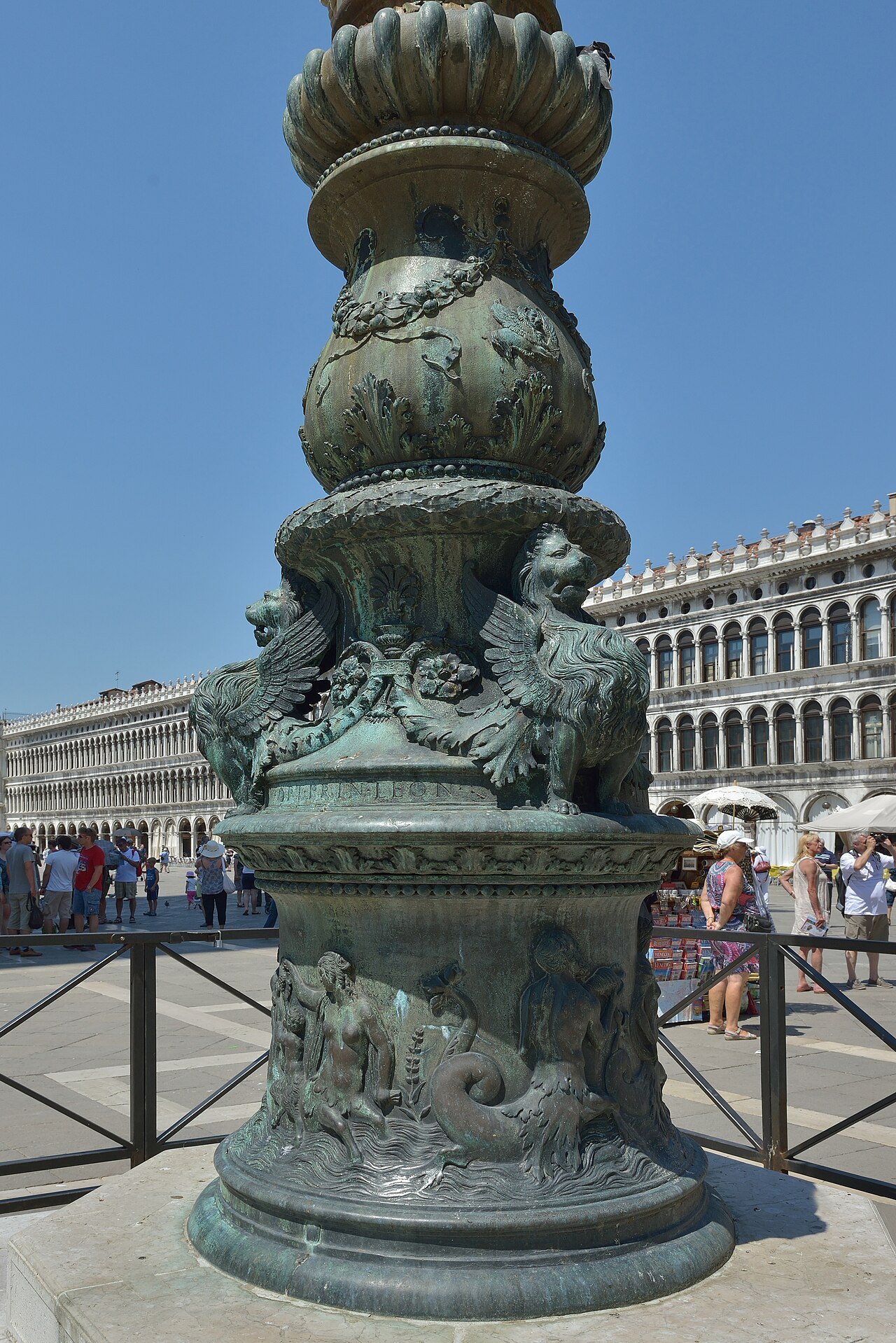
The other column carries the winged lion of Saint Mark, the symbol that appears throughout Venice on buildings, flags and official seals. It is easy to take the lion for a purely Venetian invention, but its form has been traced back, at least in part, to an ancient monument from Tarsus, carried to Venice and reworked for its new role.
Together the two figures stood for the city's double patronage, Saint Theodore the older protector and Saint Mark the saint whose relics gave the basilica its name and its claim to authority. Visitors who want the fuller story of that claim and the building behind it should see the companion page on St Mark's Basilica.
A harder history
The space between the two columns had a second, darker use. Public executions were carried out there, in the open ground facing the water, where the largest number of people could see them and where arriving visitors would also pass. It was a visible, central stage for the Republic's justice, not a hidden corner of the city.
That history sits alongside the columns' role as a ceremonial gateway, and both uses depended on the same quality: the open space between the shafts was the most exposed and most public point in the entire square, visible from land and from the water alike.
Nothing in the Piazzetta today marks the site of executions, and nothing is needed to appreciate the columns simply as they stand. But the two functions, welcome and punishment, both drew on the same prominent position at the edge of the lagoon.
What stands around them
Opposite the Doge's Palace, on the far side of the Piazzetta, runs Sansovino's Library, begun in 1537 to house the Biblioteca Marciana and completed by Vincenzo Scamozzi. Palladio is said to have called it the most magnificent and ornate building raised since antiquity, a judgment Venetians still like to repeat.
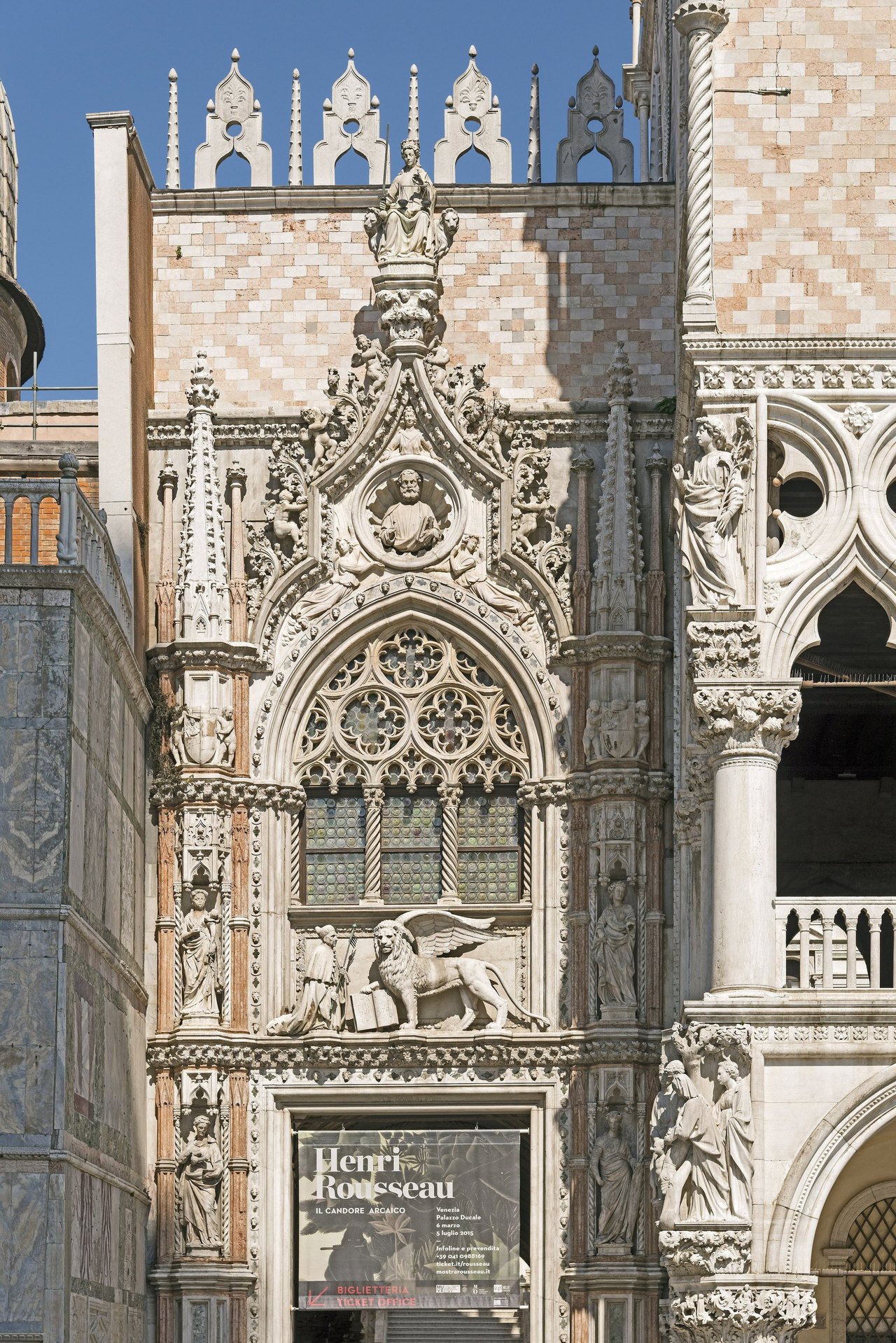
Beyond the Library, toward the water, stands the Zecca, the Republic's old mint. On the other side of the Piazzetta runs the long arcaded flank of the Doge's Palace, with the ceremonial gateway known as the Porta della Carta, built between 1438 and 1443, at the corner nearest the basilica.
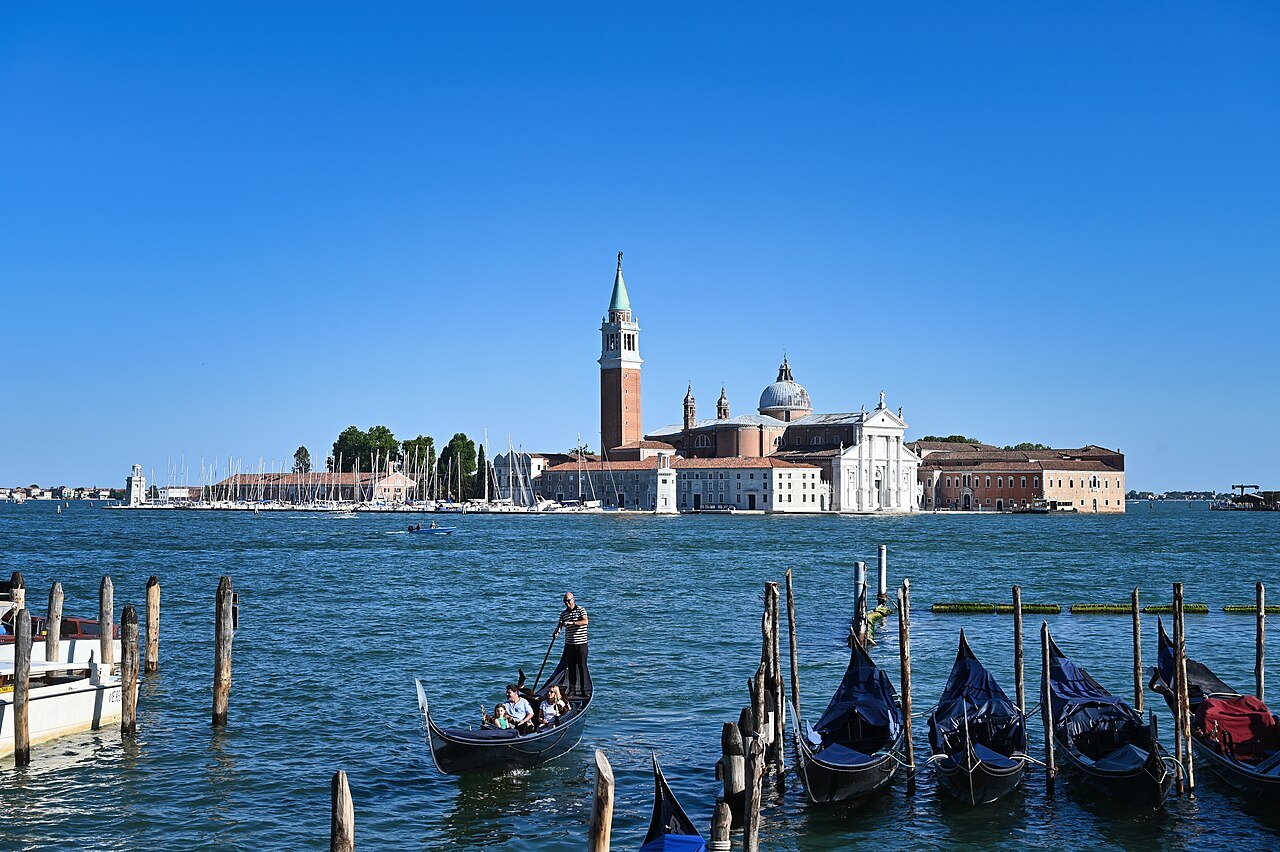
From the columns themselves, looking out across the basin, the view takes in the white facade of Palladio's church on San Giorgio Maggiore, a sightline that has barely changed since the columns were raised, even as the water's edge itself has shifted back from where it once stood.
Seeing them for yourself
The Piazzetta, like the rest of the square, belongs to everyone and costs nothing to walk through or stand in; only the buildings around it, the palace, the basilica and the Library among them, charge for entry, and any specific arrangements for a visit should be checked directly with the relevant museum or the city's official sites.
The square sits at a low elevation and is among the first parts of Venice to flood in acqua alta, since water that normally drains away through the Piazzetta's gutters rises back up through them when the sea itself is high. Anyone visiting in the wetter months should check current conditions with the city's official channels before setting out.
Early morning and late evening, when the crowds thin, are the best times to take in the columns and the open water beyond them without competing for space, a point the main Piazza San Marco page makes about the square as a whole.
Honest notes
Much of what makes the Piazzetta and its columns impressive did not originate in Venice. Like the Tetrarchs and the Pillars of Acre beside the basilica, brought from Constantinople after the Fourth Crusade, the lion on its column has roots that reach back to a much older monument far from the lagoon.
The precise dating of the columns to around 1268 is itself an estimate reached by later scholars rather than a fact recorded at the time, and visitors should treat it, like much of the square's early history, as the best current understanding rather than a settled certainty.
What can be stated plainly is simpler: two granite columns stand at the water's edge of the Piazzetta, one carrying a saint, the other a lion, and together they have marked the formal edge of Venice for roughly seven and a half centuries.
Read nextIII
More from the journal
- The Doge's PalaceCan you walk across the Bridge of Sighs?Yes: the Bridge of Sighs is part of the visit to the Doge's Palace, which crosses it to the New Prisons and comes back the other way. What the bridge was really for, where the romantic name came from, how the palace route reaches it, and where to stand for the classic view from outside.Read the piece →
- When to ComeAcqua Alta in Venice: the Tide, the Sirens and the WalkwaysBetween autumn and spring, exceptional tides flood the lowest parts of Venice. What causes the acqua alta, how the levels are measured, what the sirens mean, where the raised walkways go, what the MOSE barriers changed, and how to plan a day around a high tide.Read the piece →
- St Mark's BasilicaHow do you visit St Mark's Basilica?St Mark's is a working church with four separate visits, a line that crosses the Piazza on busy days, and a golden interior that rewards knowing where to look. How the visit is divided, how to book, when to go, and a route through the church, the Pala d'Oro and the loggia of the horses.Read the piece →