The answer in fullII
Read on
Why the Assumption Dominates the Church
The Frari's high altar carries Titian's Assumption of the Virgin, consecrated on that altar in 1469 and still the single image the entire nave is designed to lead toward. The scene shows the Virgin rising above the apostles, painted for a church that is one of the largest in Venice and built to carry a great deal of art without becoming cluttered.
The painting's fame rests partly on how it is seen. Walking up the nave, a visitor meets the choir screen of 1475 first, its central arch framing the distant Assumption like a picture within the architecture. Only after passing through the screen, into the choir itself, does the painting become a full-size canvas rather than a bright shape at the end of a tunnel of columns.
That staged approach was deliberate on the church's part, even if the painting came later. The screen was built so that the friars at prayer in the choir were set apart from the congregation in the nave; it happens also to turn the walk toward the altar into the slow reveal that now draws visitors toward the same spot.
The Only Rood Screen Left in Venice
The screen framing the Assumption is not simply decorative. It is the only rood screen still standing in any Venetian church, built in 1475 to separate the choir, where the Franciscan friars sang the office, from the nave used by the lay congregation. Elsewhere in Venice such screens were removed over the centuries; here it survives intact and in daily use by a parish community.
Beyond the screen, the choir itself holds carved wooden stalls by Marco Cozzi, arranged for the friars who once prayed in front of the altarpiece rather than beneath it, as congregations do in churches without a screen. The tombs of two doges, Francesco Foscari and Niccolò Tron, stand in the chancel beside the Assumption, giving the altar a civic as well as a religious audience.
Visitors who want to understand why the painting looks the way it does from the nave should walk the route twice: once from the west doors, taking in the long view through the arch, and once again from inside the choir, close to the canvas, where the scale and the color read very differently.
Titian's Other Altarpiece, and His Tomb
Titian painted a second major altarpiece for the Frari, the Pesaro Madonna, which hangs on the north wall of the nave rather than on the high altar. It was commissioned by Jacopo Pesaro, a bishop and naval commander, whose family had already paid for a chapel in the church; the two paintings let a visitor compare Titian's work in a single building.
Titian is buried in the Frari himself, and a monument to him stands in the nave not far from the Pesaro Madonna, near the vast mausoleum built for Doge Giovanni Pesaro. The pairing of painter and patron's family, in the same stretch of church, is one of the things that makes the Frari feel less like a museum and more like a place still organized around its donors.
Across the nave is a white marble pyramid with mourners filing through an open door, built by the pupils of sculptor Antonio Canova after a design Canova himself had drawn for an unbuilt tomb of Titian. Only Canova's heart is buried inside it; the structure is best read as a tribute to Titian redirected onto his own admirer.
A Church Built Around Its Altar
The Frari's scale explains why the Assumption works as it does. Franciscan friars received the land from the city in 1231, under Doge Jacopo Tiepolo; frari is the Venetian word for friars. Their first church proved too small, and a larger one with three naves, begun in 1250, was not finished until 1338.
Work on the church seen today began almost immediately afterward, taking more than a century and turning the building so that its front faces the campo and the small canal beside it. The builder Jacopo Celega started the work and his son Pier Paolo completed it; the bell tower, second tallest in the city after the Campanile of San Marco, was finished in 1396, and the facade in 1440.
The high altar, where the Assumption now hangs, was consecrated in 1469, and the whole church was consecrated as Santa Maria Gloriosa on 27 May 1492. Inside, a Latin-cross plan with aisles, round columns and a high Gothic rib vault braced by wooden tie beams gives the Assumption a very large stage, with no central dome to compete with it.
Other Art to See on the Way
The Assumption is the reason most visitors come, but the Frari rewards slowing down elsewhere too. The sacristy holds Giovanni Bellini's triptych of the Madonna and Child with saints, and a chapel off the south choir holds Donatello's Saint John the Baptist, his first documented work in the city, carved well before Titian's altarpiece arrived.
Funerary monuments line the nave and transepts: Paolo Savelli's tomb carries the first Venetian monument to include an equestrian statue, Benedetto Pesaro lies in a tomb by Lorenzo Bregno over the sacristy door, and the composer Claudio Monteverdi is buried in the chapel of the Milanese merchants' community, among the generals and sea captains who also lie here.
Chapel altarpieces add further layers: Bartolomeo Vivarini's Saint Mark Enthroned in the Corner chapel, added in 1420, and Alvise Vivarini's Saint Ambrose and other saints in the north transept, his last work. None of this competes with the Assumption for attention, but together it explains why the church holds more art than most museums.
Planning a Visit to See It
The Frari is a working parish church that charges for visits outside services, with current times and any charge set out on its official site, which also lets visitors request a guided visit with a Franciscan friar. Groups do not need to book ahead, but the church can close without notice for services, concerts or special events.
Allow about an hour for a first visit, more if the Titians and the chapels are to be looked at properly. The best sequence is the one the building sets up: the long view of the Assumption from the nave through the screen's arch, then a second look from inside the choir, close to the canvas.
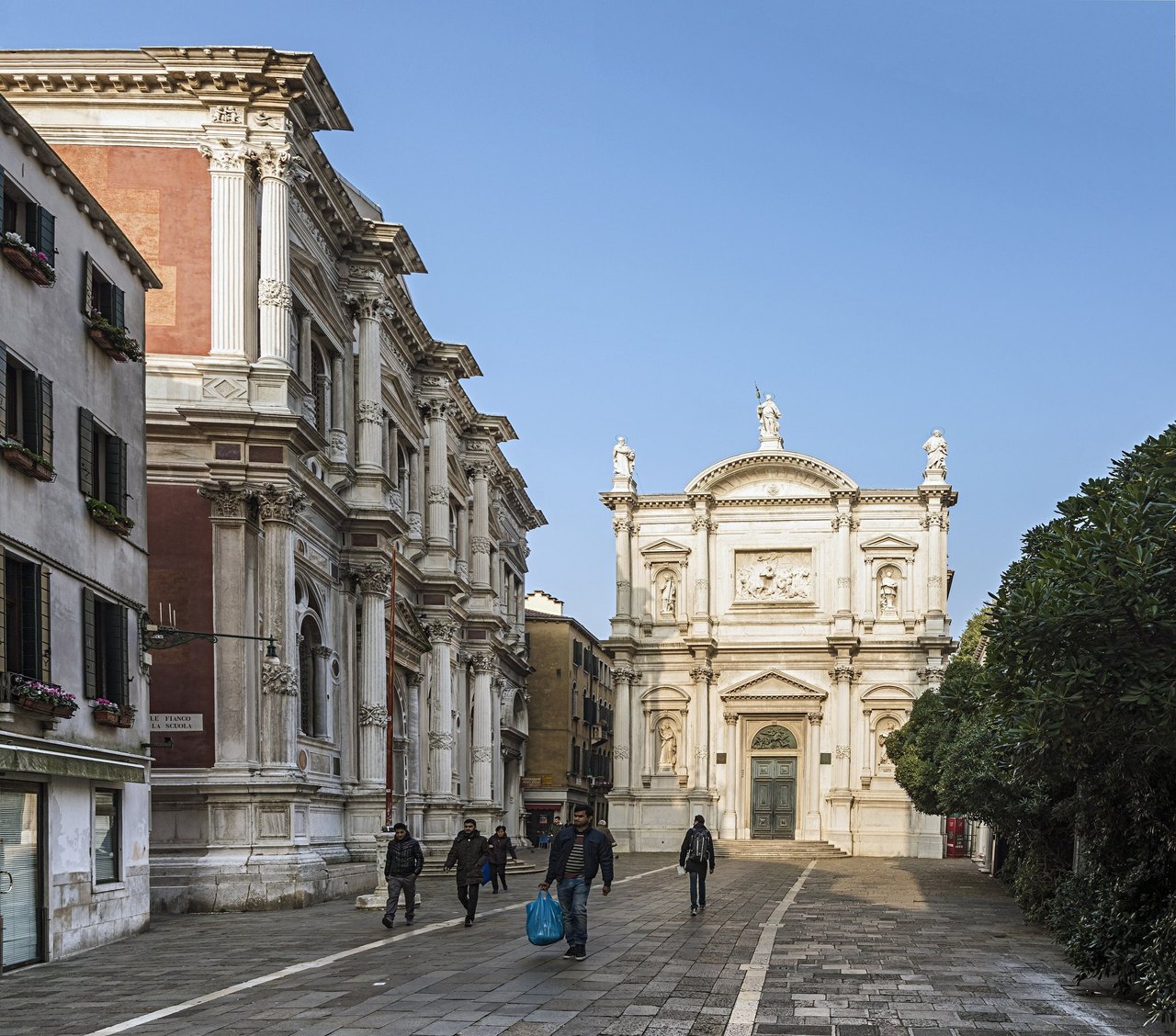
The Scuola Grande di San Rocco, with its Tintorettos, stands next door, and pairing the two makes for one of the strongest mornings of sightseeing in the city; see San Rocco for details. The Rialto market, a short walk away, is worth combining with the visit; see the Rialto market for what to expect there.
Honest Notes on the Building
The bell tower that rises beside the Assumption's church has needed structural help more than once. Cracks appeared in it in 1904, after the fall of the Campanile of San Marco alarmed the whole city, and long investigations beginning in 1990 led to a strengthening campaign in the early 2000s, including a steel cable, grouting of the soil beneath the tower and a structural joint between tower and church.
The Franciscans who commissioned and maintained the church were themselves expelled from it in the nineteenth century; the order was not given the Frari back until 1922. The building a visitor sees today, and the Assumption at its center, survived that gap and the engineering work on the tower that followed.
For anything related to opening arrangements, charges or closures around services and events, the church's official site and the parish are the sources to check before planning a visit, especially if the trip is built around seeing the Assumption on a particular day, since concerts and ceremonies can close the nave without much notice.
Read nextIII
More from the journal
- The CampanileWhy did the Campanile of San Marco collapse in 1902?How the medieval Campanile collapsed in 1902 and was rebuilt exactly as it was, where it was.Read the piece →
- St Mark's BasilicaWhat is the Pala d'Oro, and why is it behind the altar?How the Pala d'Oro's Byzantine enamels came to Venice, and why they stand behind the altar over the saint's relics.Read the piece →
- When to ComeAcqua Alta in Venice: the Tide, the Sirens and the WalkwaysBetween autumn and spring, exceptional tides flood the lowest parts of Venice. What causes the acqua alta, how the levels are measured, what the sirens mean, where the raised walkways go, what the MOSE barriers changed, and how to plan a day around a high tide.Read the piece →