THE FASTEST SHIPYARD IN EUROPEI
How did the Arsenale build a galley in a single day?
How Venice's state shipyard, the Arsenale, built and armed a galley almost every day at its sixteenth-century peak.
The answer in fullII
Read on
A galley a day, explained
The idea that Venice built a galley in a single day is one of the most repeated claims about the Arsenale, and it comes from the record of the yard at its peak, in the early sixteenth century. At that time it employed some sixteen thousand people and could turn out, arm and provision nearly one galley a day, keeping up to a hundred vessels in different stages of building at once.
That was not one crew finishing a ship from scratch each morning. It was a continuous system, refined over centuries, in which many hulls moved through many stages at the same time, so that a finished galley could emerge from the far end of the yard on most days without any single team working any faster than usual.
A state yard may have existed here as early as the eighth century. The present Arsenale is traditionally said to have begun in 1104 under Doge Ordelafo Faliero, though no evidence supports so precise a date. At first it mainly repaired privately built ships, before growing into something far larger.
In 1320 the much larger Arsenale Nuovo was added beside the old yard. From then on, the navy's warships and the Republic's great merchant galleys could be designed, built, armed and fitted out in one enclosed complex, rather than scattered among private builders around the lagoon.
An assembly line before the word existed
Venice developed shipbuilding methods no rival matched. Galleys were built frame first, faster and with less timber than the older hull-first method used elsewhere, and standardized, interchangeable parts were used across the fleet, so shipwrights were not shaping every piece anew for every hull that came through.
The real innovation was movement. Hulls were floated along a canal from one stage to the next: framing, then planking and cabins, then final assembly, so that the work came to the workers rather than workers following a single ship from keel to launch, as elsewhere.
Timber came from the Republic's own forest in the hills of the Veneto, kept under state control so supply never depended on outside merchants or seasonal shortages. Cut parts, standard fittings and a fixed route through the yard meant each stage could proceed at a steady, predictable rate.
Once a hull had been framed and reached its place in the sequence, planking, rigging and provisioning could follow within a single working day, which is most likely where the famous claim comes from: not a ship built from nothing overnight, but one completed on schedule.
The people behind the production line
None of this ran itself. At its peak the Arsenale employed some sixteen thousand people, a workforce drawn largely from the neighborhood that grew up around the yard: the arsenalotti, whose housing spread outside the walls in this corner of Castello and who formed a distinct trade community tied to the state for generations.
Rope-making became one of the Arsenale's great trades, alongside carpentry, caulking and ironwork, each handled by specialists who stayed at their post along the line rather than following one vessel through every stage. Keeping the fleet at sea cost the government almost a tenth of its revenue.
By 1450 more than three thousand Venetian merchant ships were at sea, a fleet the Arsenale's methods made it possible to build, repair and replace at the pace trade and war required, year after year, without the yard ever standing idle for long.
The complex has been called the largest industrial complex in Europe before the Industrial Revolution, and Dante, who likely saw something of it, wrote it into his Inferno, comparing the boiling pitch of Hell to the Arsenale's own cauldrons of tar.
Galleys, guns and Galileo
The Arsenale built more than merchant galleys. It also cast guns, from bombards in the 1370s to handguns, and in the sixteenth century it developed ships meant to carry heavy artillery: the galleass, used at the Battle of Lepanto in 1571, and the galleon, a slimmer armed sailing ship.
From 1593 Galileo advised the Arsenale's engineers on ballistics, instruments and the rowing of galleys, and what the shipwrights knew about hulls and timber fed into his later work on the strength of materials, a rare case of practical craft shaping theoretical science.
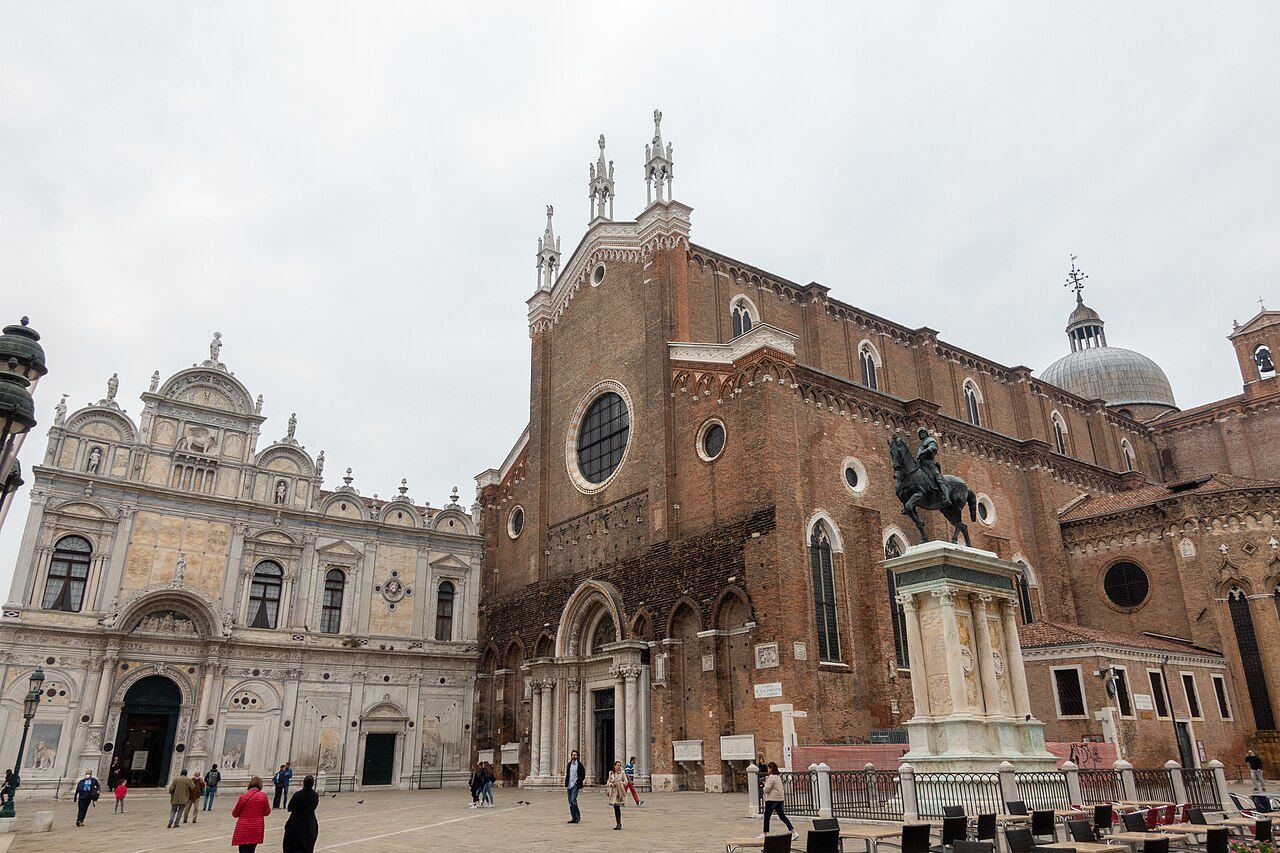
The Arsenale's lighter guns also went to war on land. The condottiere Bartolomeo Colleoni, whose statue stands at Santi Giovanni e Paolo, is usually credited as the first to mount them on mobile carriages, changing how armies used artillery in the field.
The Republic extended this network beyond the city, building smaller arsenals and repair yards along its sea routes in Greece and Crete, at Corfu, Methoni, Koroni, Chania and Heraklion among others, so that a Venetian galley was rarely far from a dockyard able to keep it at sea.
What you can see from outside
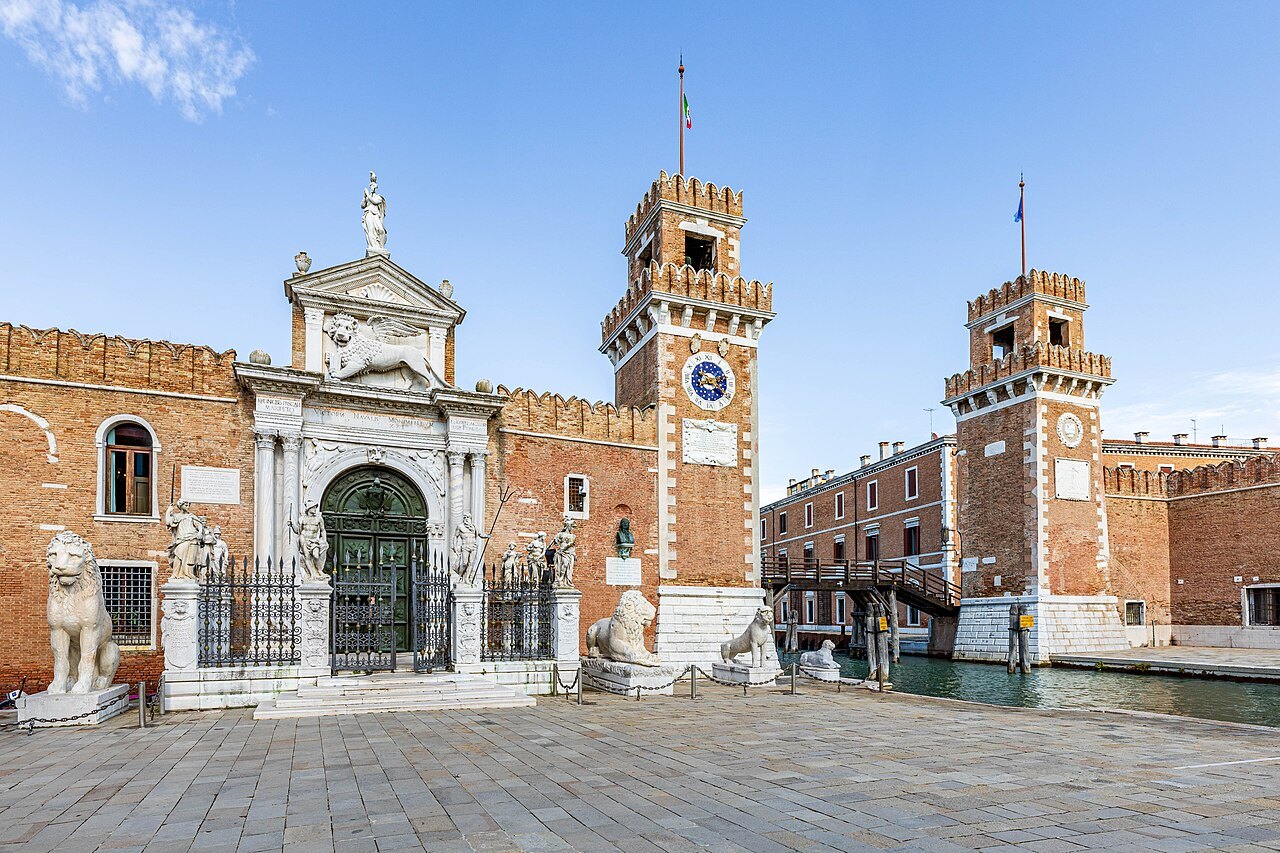
Most of the Arsenale is off limits to the public, so the sight today is its edges. Start at the Campo dell'Arsenale, where the Porta Magna, the great land gate, stands beside two towers, built around 1460 and modeled on the Roman Arch of the Sergii at Pula in Istria, then Venetian territory.
It is one of the earliest Renaissance works in the city, and the winged lion of Saint Mark stands over the arch. In front of the gate sit ancient marble lions brought back from Piraeus, the port of Athens, and set here in 1687.
The largest, the Piraeus Lion, has runes cut into its flanks, probably carved by Scandinavian mercenaries in the eleventh century, worth a close look if you come near enough to the stone.
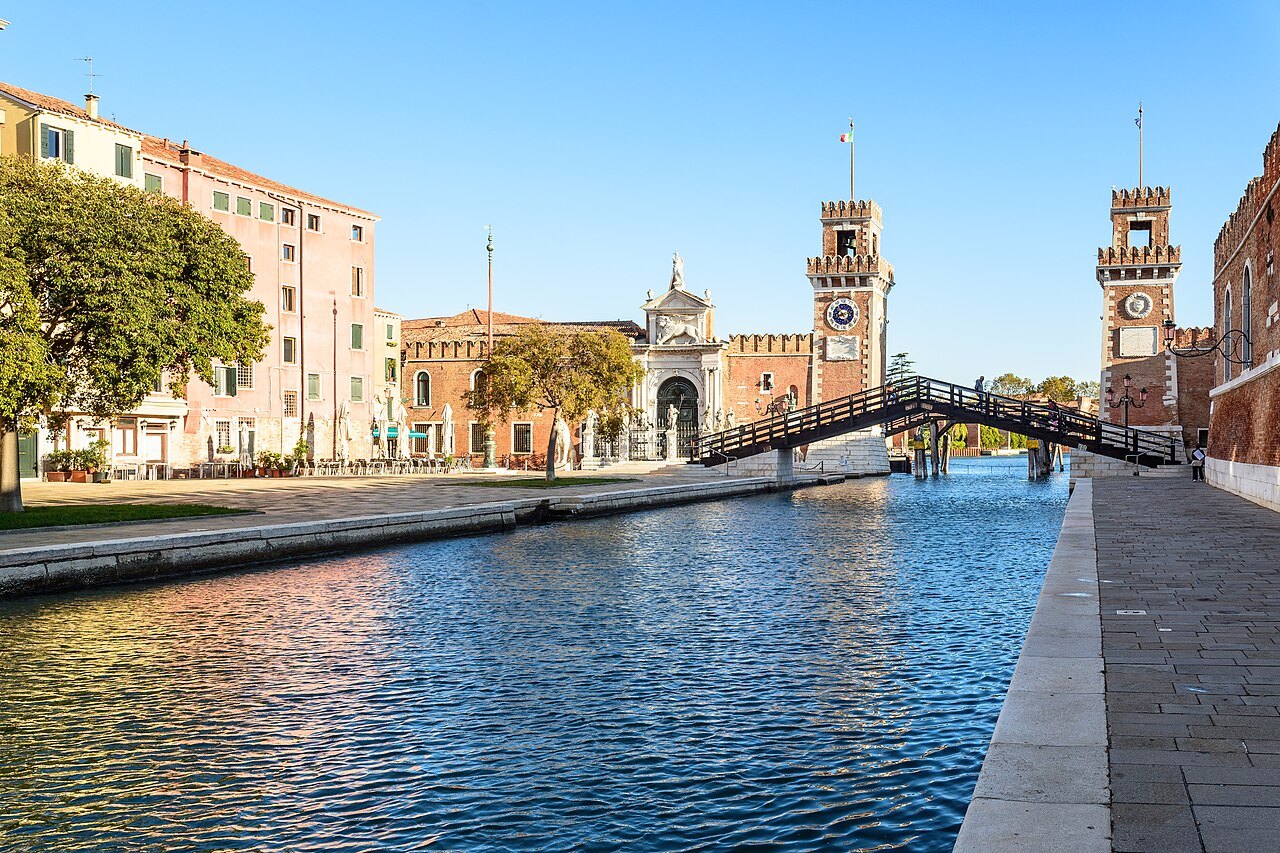
From the wooden bridge beside the gate, look along the Rio dell'Arsenale to the water entrance, flanked by two tall crenellated towers, where the galleys once came out into the lagoon. Walking the outside walls on the Fondamenta dell'Arsenale and Fondamenta dei Forni gives a sense of scale: the rampart runs for about two miles.
The Arsenale today
Much of the Arsenale was destroyed under Napoleonic rule and later rebuilt for use as a naval base, a role part of it still holds. Other sections, restored after years of neglect, now house a research center, a center for preserving historic boats, and exhibition spaces used during the city's great art exhibition.
Part of the complex also serves as the operations center of the MOSE flood barriers described on the lagoon page, which now protect the lagoon from the highest tides, linking the old shipyard to the city's present defenses against the sea.
Nearby stands the Museo Storico Navale, the naval history museum, which belongs to the same story and fills in detail that the closed walls cannot show a visitor standing outside them.
How to visit
The walls, the gate, the lions and the canal can be seen at any time from outside, at no cost. The inside of the Arsenale opens to visitors mainly when exhibitions are held there, so check what is on before planning a visit around it, with the city's official listings or the exhibition organizers.
The nearest water-bus landing is Arsenale, on the Riva; confirm routes and schedules with ACTV or see getting around. On the north side of the city a landing called Bacini sits inside the old basins, giving a glimpse within the walls without needing to enter them.
The site fits naturally into a longer walk through Castello, from Santi Giovanni e Paolo east to the Arsenale and on to the gardens and Sant'Elena, or along the Riva degli Schiavoni from the Doge's Palace, placing the shipyard in the context of the empire it built.
Read nextIII
More from the journal
- Santi Giovanni e PaoloWho was Colleoni, and why is his statue outside Santi Giovanni e Paolo?Inside Venice's pantheon of doges, and the fierce bronze captain who guards its square.Read the piece →
- When to ComeAcqua Alta in Venice: the Tide, the Sirens and the WalkwaysBetween autumn and spring, exceptional tides flood the lowest parts of Venice. What causes the acqua alta, how the levels are measured, what the sirens mean, where the raised walkways go, what the MOSE barriers changed, and how to plan a day around a high tide.Read the piece →
- Getting AroundHow the Vaporetto Works: Tickets, Passes and LinesThe vaporetto is Venice's bus: numbered lines run by ACTV along the Grand Canal, around the city and out to the islands. How single tickets and time-based travel cards work, how to decide between them, how to validate, and which lines a visitor actually uses.Read the piece →