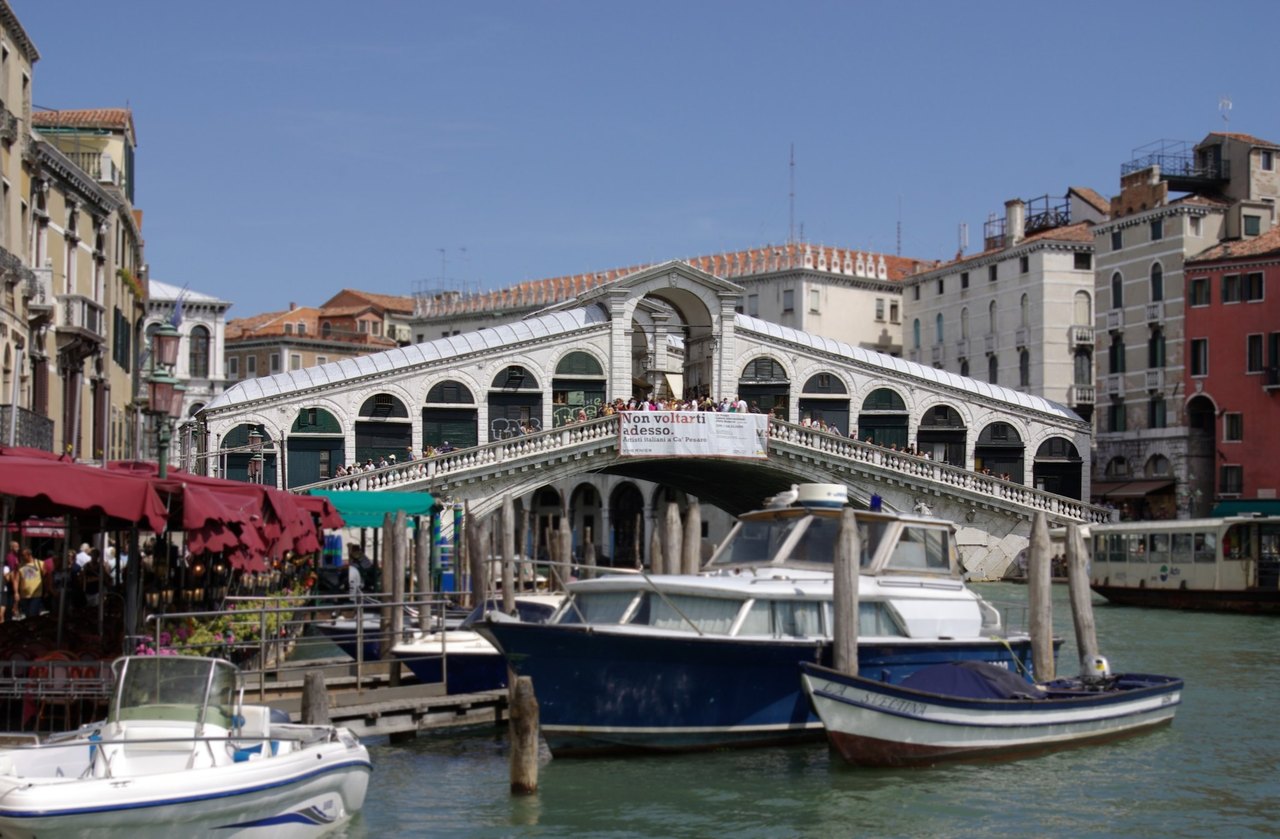
FROM FLOATING PONTOON TO STONE ARCHI
Why was the Rialto Bridge built of stone after so many wooden ones?
Why timber bridges at the Rialto kept failing, and how Antonio da Ponte's single stone arch finally replaced them.
The answer in fullII
Read on
A Question of Stone
The Rialto Bridge is the oldest of the four bridges across the Grand Canal, and until the Ponte dell'Accademia was built in 1854 it was the only one. It joins the sestieri of San Marco and San Polo at the point where the city began: the islands of Rivoalto, where the doge moved his seat in the early ninth century and where the market has stood since 1097.
The stone bridge crossed today was designed by Antonio da Ponte and built between 1588 and 1591. It is one broad arch carrying two covered ramps of shops that climb to a portico at the top. Its engineering was thought so daring that the architect Vincenzo Scamozzi predicted it would fall. It has stood for more than four centuries, answering the question its own construction raised.
The question the title asks is really two questions: why did centuries of wooden bridges fail, and why did Venice finally accept a single daring arch over the many-arched classical designs its own architects preferred. The answer lies in both engineering and politics, and in the many designs tried and discarded before 1588.
Boats, Then Timber
The first crossing here was not a bridge at all but a pontoon of boats, built in 1181 by Nicolò Barattieri and known as the Ponte della Moneta, after the mint that stood near its eastern end. As the Rialto market on the far bank grew, so did the traffic crossing the water, and around 1255 the pontoon was replaced by a wooden bridge.
That wooden bridge had two inclined ramps meeting at a central section that could be raised to let tall ships pass beneath. In the first half of the fifteenth century, rows of shops were built along its sides, their rents paid into the state treasury to cover the bridge's upkeep, a practical arrangement that the stone bridge later inherited directly, shops and all.

That system combined commerce with maintenance: the bridge paid for itself through the trade crossing it, an arrangement Venice found too useful to abandon even as the wood beneath began to fail. The raised central section answered a practical problem, tall-masted ships needing to pass the Rialto to reach moorings further up the canal.
A Century of Collapses and Indecision
Timber did not hold up well. The bridge was damaged in 1310 during the revolt of Bajamonte Tiepolo, collapsed in 1444 under the weight of a crowd gathered to watch the bride of the Marquis of Ferrara pass, and collapsed again in 1524. Each failure made the case for something sturdier, but sturdier took a long time to agree on.
A stone bridge was first proposed in 1503, and for more than eighty years projects came and went without result. The most famous architects of the age entered the field, Jacopo Sansovino, Andrea Palladio and Vignola among them, all proposing classical bridges carried on several grand arches rather than one span.
Palladio drew two versions, each remaking the whole Rialto area with a colonnaded square for trade at either end of the bridge, and Michelangelo was also considered as a designer. Grand as these schemes were, the many-arched designs were judged inappropriate to the site, a narrow stretch of the Grand Canal already busy with boats and market traffic.
Why a Single Arch Won
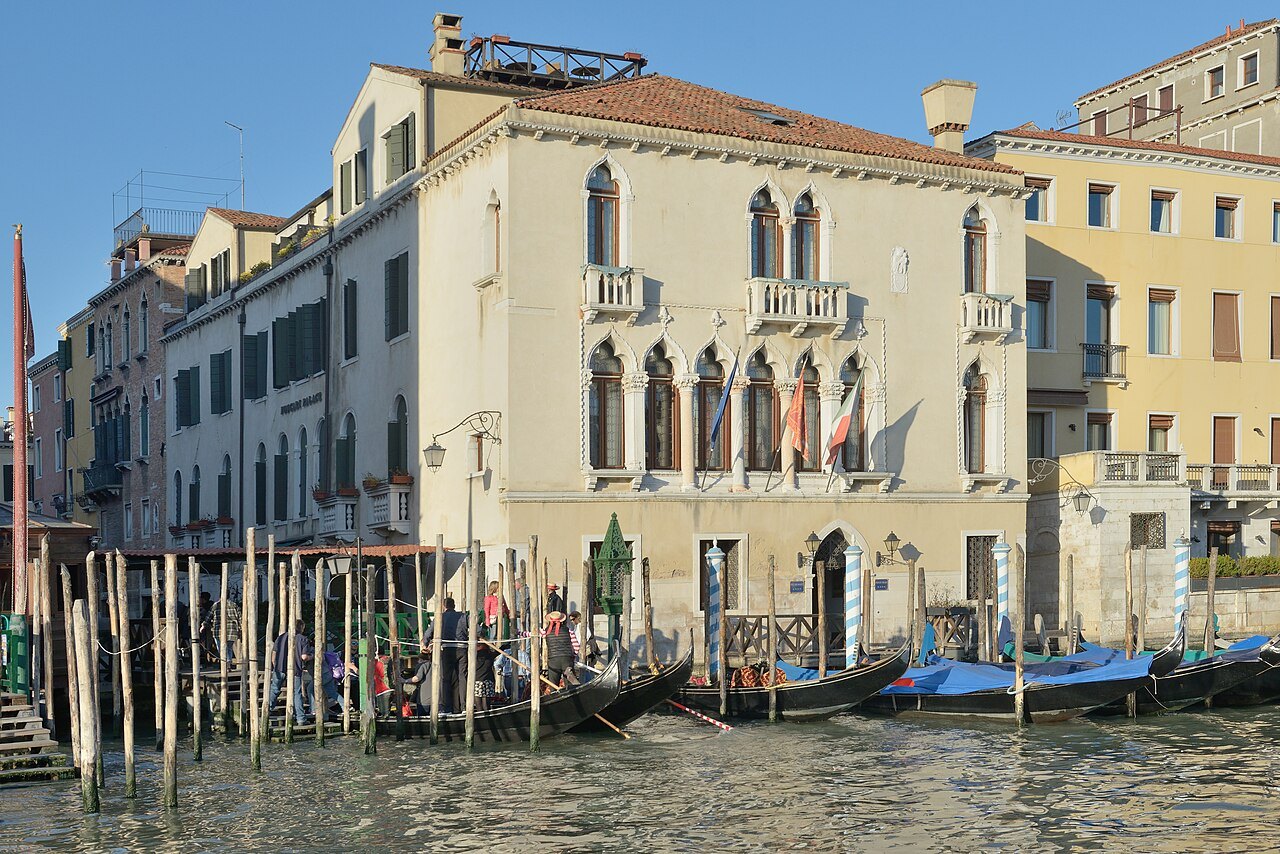
The competition reopened in 1587, and Antonio da Ponte won it against Scamozzi, the same architect who had warned the result would fall. His design was chosen on the ninth of June, 1588, because it crossed the canal in a single arch, with no central pier to obstruct the busiest stretch of water in the city.
That single span rests on roughly twelve thousand elm piles driven into the mud of the canal bed, the same foundation technique used for the palaces lining the Grand Canal. The bridge measures about forty-eight meters long and twenty-two meters wide, and its arch spans roughly twenty-eight meters at the base, rising about seven and a half meters above the water, dimensions large enough to carry two ramps of shops and still let shipping pass.
The decision also mattered for the bridge's double life as a market. Because there was no central pier to interrupt the climb, the twenty-four shops built into the ramps could run unbroken from bank to bank, continuing the rent-for-upkeep arrangement that had supported the wooden bridge for over a century.
What You Actually See
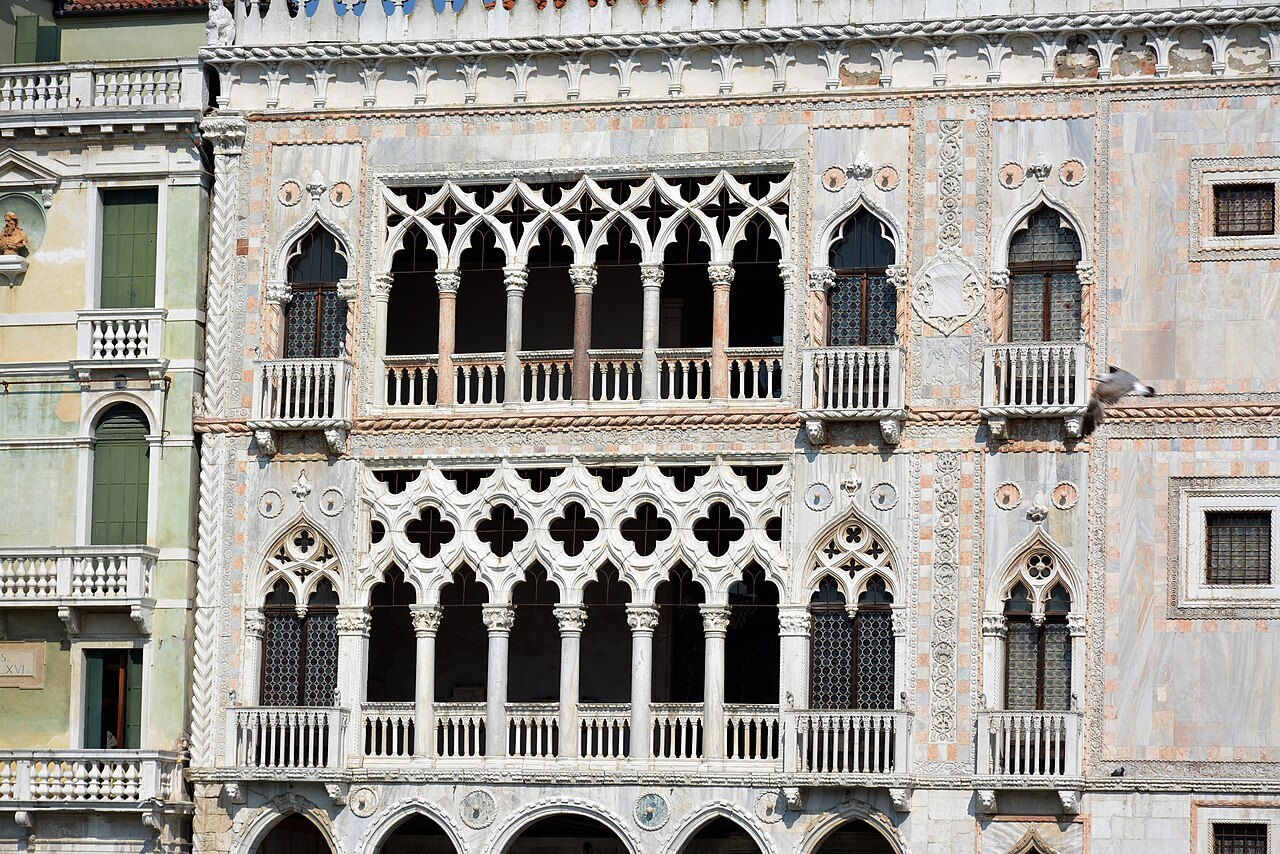
Before crossing, stand on the Riva del Vin, the old wine quay at the San Polo foot, or on the Riva del Ferro opposite, and look at the bridge whole. From here the single arch, the covered ramps and the portico at the summit are visible together in a way no view from the bridge itself allows.
On the south face are relief figures of the Annunciation, the angel on the left, the dove of the Holy Spirit at center, the Virgin on the right, a reminder that Venice dated its founding to the feast of the Annunciation. On the opposite face, Saint Mark and Saint Theodore, the city's patrons, are carved in high relief, and inscriptions record that the bridge was built under Doge Pasquale Cicogna in 1591.
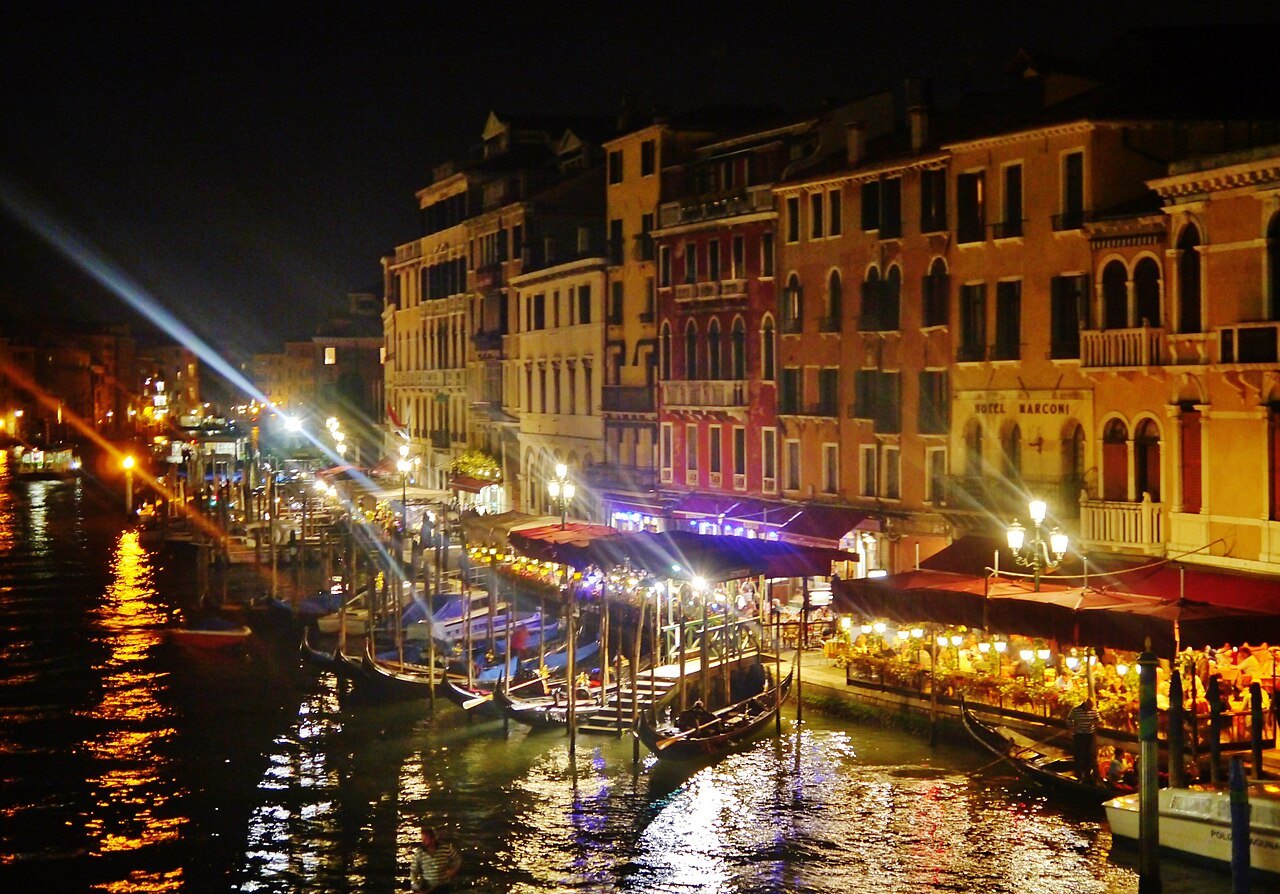
Climb the ramps between the shops, twenty-four in all, six to each side, each about three meters wide. At the top, under the portico, the views open both ways along the busiest stretch of the Grand Canal: south toward the curve by Ca' Foscari, north toward the Fondaco dei Tedeschi and the market.
How to Visit
The bridge is free and always there, but it is also one of the most crowded places in Venice. The ramps and the top are packed from mid-morning into the evening in season, so come early, or late, when the shops are shuttered and the canal below is quieter than at any other hour.
The best views of the bridge are not from it but of it, from the Riva del Vin, from the landing stages on either bank, or from a water bus. Line one of the vaporetto passes slowly beneath it, and a traghetto crosses nearby at Santa Sofia; check current routes with ACTV before relying on either.
Combine the bridge with the market on the San Polo side, liveliest in the morning, and the church of San Giacomo di Rialto beside it, by tradition the oldest in the city. From the San Marco foot, the Mercerie lead through narrow shopping streets toward Piazza San Marco and the heart of the city.
Myths and Honest Notes
The doubters who swore the stone bridge would never stand became a joke carved in stone. Legend holds that one man declared a nail would grow on a very private part of him if it held, and one woman said something equally rude about herself. Two capitals on the Palazzo dei Camerlenghi, easy to see from the ramp, are said to show them, proof the Republic heard every rumor and answered it with humor.
The bridge has been restored several times since 1591, including work in 1824 and 1852, and the most thorough restoration since its construction ran from 2015 to 2019, paid for by a single private sponsor. The nickname Shylock's bridge comes from Browning, borrowed from Shylock's line to Antonio about the Rialto in The Merchant of Venice.
Visitors curious about exactly which stones date to da Ponte's own build, after restorations in 1824, 1852 and a private-funded campaign from 2015 to 2019, should not expect a simple answer on site. The city's official sites are the place to check for current details on conservation work before planning a visit around it.
Read nextIII
More from the journal
- Getting AroundOnly Four Bridges Cross the Grand Canal: Planning RoutesThe Grand Canal cuts Venice in two, and only four bridges cross it in nearly four kilometers. Where they are, why a map misleads, and how to plan walks, water-bus rides and traghetto crossings so the canal works for you rather than against you.Read the piece →
- The Grand CanalHow are the palaces of the Grand Canal kept standing on wooden piles?How wooden piles, Istrian stone, and brick keep the Grand Canal's palaces standing above the lagoon mud.Read the piece →
- Getting AroundThe Traghetto: Venice's Cheapest Gondola CrossingOnly four bridges cross the Grand Canal. Between them, a traghetto, a plain gondola rowed by two oarsmen, ferries foot passengers straight across. What it is, where the crossings are, how to ride one, and why it is worth knowing about.Read the piece →